




Wednesday, 20 May 2026 03:55 AM
Company Update
Demand for toughening nanoparticle additives is rising across aerospace, wind energy, and EV composites as manufacturers seek stronger, lightweight epoxy systems.
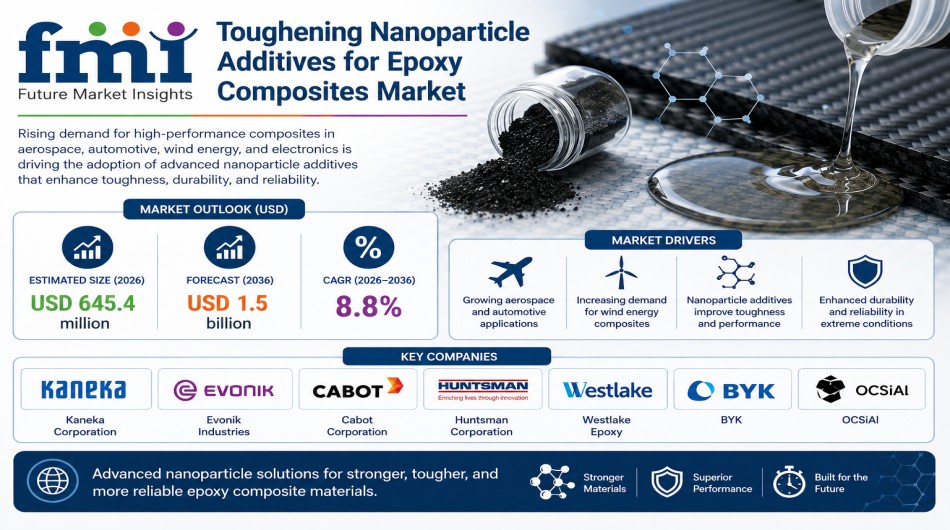
NEWARK, DE / ACCESS Newswire / May 20, 2026 / According to the latest market analysis by Future Market Insights, the global toughening nanoparticle additives for epoxy composites market is projected to grow from USD 645.4 million in 2026 to USD 1.5 billion by 2036, registering a CAGR of 8.8% during the forecast period.
Growth in the market is being driven by rising demand for stronger and lighter composite materials across wind energy, aerospace, electric vehicles, and advanced industrial applications. Manufacturers are increasingly adopting nanoparticle toughening technologies to improve fracture resistance, fatigue durability, and impact performance in epoxy systems without compromising processing efficiency.
Quick Stats for Toughening Nanoparticle Additives for Epoxy Composites Market
Market size (2025): USD 0.6 billion
Estimated size (2026): USD 645.4 million
Forecast (2036): USD 1.5 billion
CAGR (2026-2036): 8.8%
Incremental opportunity: USD 854.6 million
Leading particle form: Pre-dispersed masterbatch (48.0% share in 2026)
Top additive type: Core-shell rubber (34.0% share in 2026)
Leading application: Structural laminates (38.0% share in 2026)
Top end use: Aerospace defense (31.0% share in 2026)
Key companies: Kaneka Corporation, Evonik Industries, Cabot Corporation, Huntsman Corporation, Westlake Epoxy, BYK, OCSiAl
Get detailed market forecasts, competitive benchmarking, and pricing trends: https://www.futuremarketinsights.com/reports/sample/rep-gb-33158
Market Size and Growth Outlook
The toughening nanoparticle additives for epoxy composites market is expected to witness strong expansion over the next decade as industries prioritize lightweight structures with higher mechanical reliability. The market's growth trajectory reflects increasing reliance on advanced epoxy formulations in demanding structural applications.
Wind blade manufacturers, aerospace OEMs, and EV component suppliers are accelerating the adoption of nano-toughened epoxy systems to improve fatigue resistance and long-term durability. Unlike traditional fillers, nanoparticle additives enable performance enhancement at lower loading levels, supporting weight reduction and better processing consistency.
Growth Drivers Supporting Market Expansion
The market is benefiting from the convergence of composite lightweighting and performance optimization trends across several industries.
Wind energy remains a major growth engine as larger turbine blades require epoxy matrices capable of handling repeated stress cycles over long operating lifespans. Increasing global wind installations are strengthening demand for advanced structural laminates with superior crack resistance.
Electric vehicle manufacturers are also expanding the use of epoxy composites in battery housings, bonded assemblies, and lightweight structural components. Toughening additives improve impact performance while maintaining low system weight, supporting EV efficiency goals.
In aerospace applications, manufacturers are prioritizing nano-toughened formulations that provide repeatable fracture toughness, stable cure behavior, and reliable laminate performance. Certification-focused industries increasingly value dispersion consistency and formulation stability during material qualification.
Challenges Limiting Faster Adoption
Despite strong demand momentum, the market faces several operational and commercial constraints.
Dispersion quality remains one of the biggest technical barriers. Nanoparticles require precise mixing and stabilization to avoid agglomeration that can compromise composite performance.
Cost sensitivity in industrial composite programs also creates pricing pressure, especially in markets where manufacturers seek lower additive loading without sacrificing toughness improvements.
Qualification timelines in aerospace and structural applications continue to slow product approvals, as resin systems must meet strict fatigue and impact testing standards before commercial adoption.
In addition, raw material and energy price volatility is influencing formulation costs, particularly for epoxy-compatible dispersions requiring advanced processing and logistics control.
Opportunities Beyond Traditional Composite Markets
The market is expanding beyond aerospace and wind energy into newer high-value applications.
Battery technologies and conductive composite systems are opening opportunities for carbon nanotube and graphene-based additives in EV platforms and electronics encapsulation.
Advanced adhesive systems and prepreg technologies are also creating demand for additives capable of improving crack resistance while maintaining processability.
Growing interest in lightweight industrial equipment and durable bonded assemblies is expected to further strengthen long-term demand for nano-enhanced epoxy systems.
Segmentation Insights
By Additive Type
Core-shell rubber is expected to account for 34.0% of additive type demand in 2026, supported by its ability to improve crack resistance without requiring major resin redesign.
Nano silica and carbon nanotube additives are gaining adoption in applications requiring stiffness control, conductivity enhancement, and improved mechanical durability.
By Particle Form
Pre-dispersed masterbatch is projected to hold 48.0% share in 2026 due to its ability to reduce mixing variability and simplify composite manufacturing processes.
Manufacturers increasingly prefer ready-to-use dispersion systems that minimize agglomeration risk and improve production consistency.
By Application
Structural laminates are expected to dominate with 38.0% market share in 2026, driven by demand from aerospace panels, wind blade skins, and advanced composite structures.
Composite adhesives and prepreg systems are also witnessing increased adoption in high-performance bonded assemblies.
Regional Dynamics: Asia Pacific Leads Global Growth
Asia Pacific continues to dominate the global market due to expanding wind energy capacity, EV manufacturing growth, and large-scale composite processing infrastructure.
China (10.8% CAGR): Leading growth market supported by strong wind blade production, EV manufacturing expansion, and domestic epoxy formulation capabilities.
India (10.1% CAGR): Rapid growth fueled by wind energy expansion and increasing local composite manufacturing activity.
USA (8.6% CAGR): Growth supported by aerospace qualification programs and EV battery material investments.
Germany (7.4% CAGR): Demand driven by wind project approvals and automotive lightweighting initiatives.
UK (6.8% CAGR): Offshore wind blade repair and aerospace composite applications continue to support market demand.
Customize insights for your business strategy@ https://www.futuremarketinsights.com/customization-available/rep-gb-33158
Competitive Landscape: Technology and Dispersion Capability Define Market Position
The competitive environment is shaped by formulation expertise, dispersion technology, and composite qualification support rather than pricing alone.
Leading companies are investing in advanced dispersion systems, technical support capabilities, and epoxy compatibility expertise to strengthen long-term OEM relationships.
Key companies operating in the market include:
Kaneka Corporation
Evonik Industries
Cabot Corporation
Huntsman Corporation
Westlake Epoxy
BYK
OCSiAl
NanoXplore
Nanocyl
Arkema
Strategic Implications for Industry Stakeholders
For composite manufacturers, resin formulators, and procurement leaders, nanoparticle toughening technologies are becoming increasingly important in next-generation material strategies.
Companies adopting advanced nano-toughened epoxy systems early may benefit from improved product durability, lower maintenance risks, and enhanced structural performance.
Strategic supplier partnerships and stable regional sourcing will become increasingly critical as demand for high-performance composites expands globally.
Investment in dispersion quality, formulation expertise, and certification support is expected to remain a key competitive differentiator across aerospace, wind energy, and EV supply chains.
Future Outlook: From Specialty Additive to Mainstream Composite Technology
The toughening nanoparticle additives for epoxy composites market is steadily transitioning from specialized formulation work into broader industrial adoption.
As wind energy systems grow larger, EV architectures become lighter, and aerospace structures demand higher fatigue resistance, nano-toughened epoxy systems are expected to play a larger role in composite engineering.
Advancements in dispersion technologies, scalable production, and resin compatibility are likely to improve adoption rates while reducing qualification risks for manufacturers.
Over the long term, the market is expected to evolve into a critical enabling segment within advanced composite materials, supporting industries focused on durability, lightweighting, and high-performance structural systems.
Executive Takeaways
Toughening nanoparticle additives are gaining commercial adoption across aerospace, wind energy, and EV composite systems.
Pre-dispersed masterbatch formats are emerging as the preferred delivery method for consistent processing performance.
Asia Pacific remains the dominant regional market, led by China and India.
Dispersion quality, certification timelines, and cost pressures remain key industry challenges.
Long-term opportunities are expanding in conductive composites, EV battery systems, and advanced structural laminates.
Companies with strong epoxy formulation expertise and technical support capabilities are expected to strengthen market positioning over the forecast period.
Unlock 360° insights for strategic decision making and investment planning@ https://www.futuremarketinsights.com/checkout/33158
Explore More Related Studies Published by FMI Research:
Epoxy Type Stabilizers Market: https://www.futuremarketinsights.com/reports/epoxy-type-stabilizers-market
Epoxy Casting Potting Resin Market: https://www.futuremarketinsights.com/reports/epoxy-casting-potting-resin-market
Additives for Metalworking Fluids Market: https://www.futuremarketinsights.com/reports/additives-for-metalworking-fluids-market
Toughening Nanoparticle Additives Market: https://www.futuremarketinsights.com/reports/toughening-nanoparticle-additives-market
UV-Blocking Nanoparticle Additives for Agricultural Films Market: https://www.futuremarketinsights.com/reports/uv-blocking-nanoparticle-additives-for-agricultural-films-market
About Future Market Insights (FMI)
Future Market Insights (FMI) is a leading provider of market intelligence and consulting services, serving clients in over 150 countries. Headquartered in Delaware, USA, with a global delivery center in India and offices in the UK and UAE, FMI delivers actionable insights to businesses across industries including automotive, technology, consumer products, manufacturing, energy, and chemicals.
An ESOMAR-certified research organization, FMI provides custom and syndicated market reports and consulting services, supporting both Fortune 1,000 companies and SMEs. Its team of 300+ experienced analysts ensures credible, data-driven insights to help clients navigate global markets and identify growth opportunities.
For Press & Corporate Inquiries
Rahul Singh
AVP - Marketing and Growth Strategy
Future Market Insights, Inc.
+91 8600020075
For Sales - [email protected]
For Media - [email protected]
For web - https://www.futuremarketinsights.com/
For Web : https://www.factmr.com/
SOURCE: Future Market Insights, Inc.