




Tuesday, 24 March 2026 08:45 AM
Company Update
Resveratrol Market: Bioavailability Breakthroughs and Encapsulation Technologies Redefine Competitive Landscape
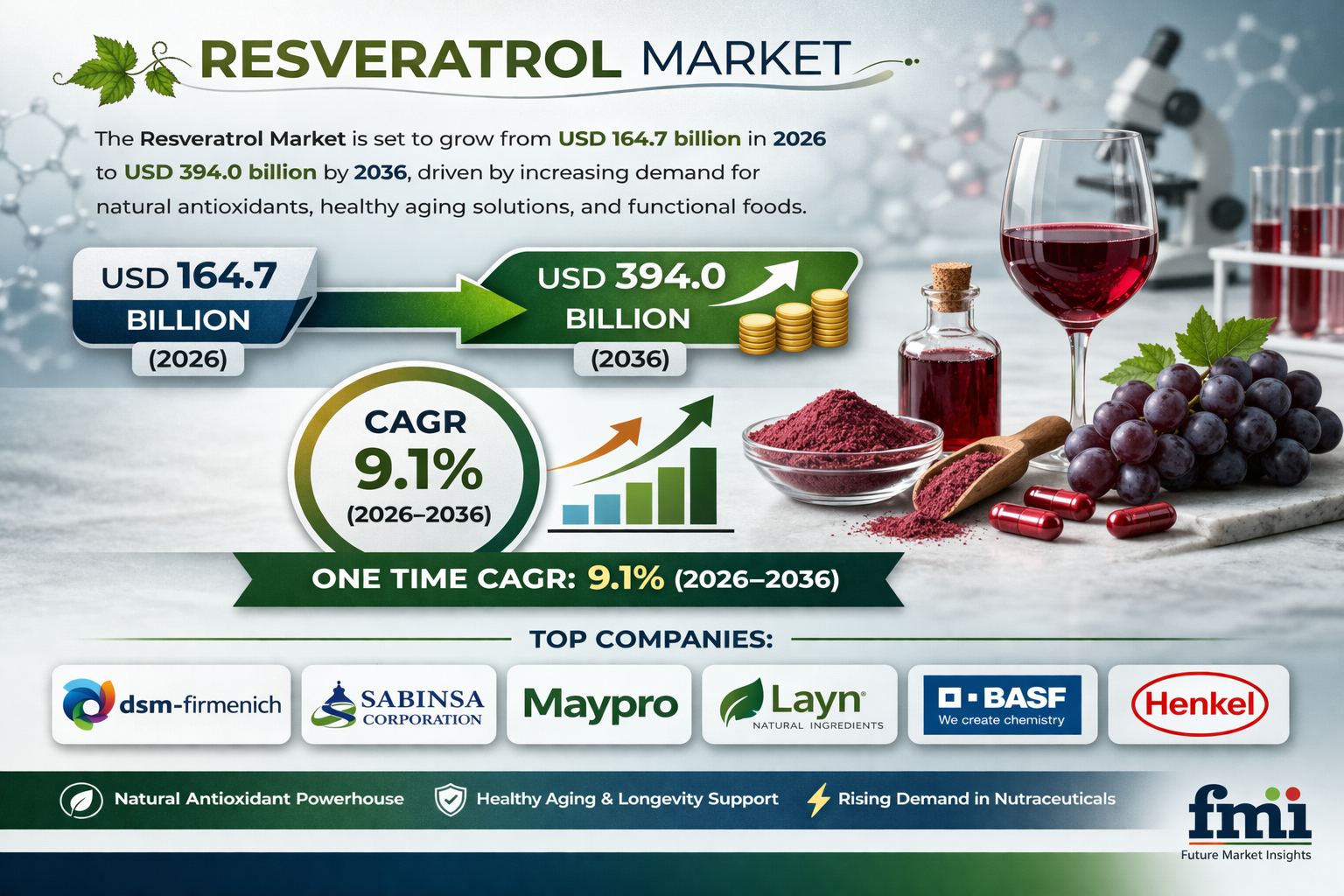
NEWARK, DE / ACCESS Newswire / March 24, 2026 / The global Resveratrol Market is entering a high-growth phase as advancements in bioavailability enhancement technologies and rising demand for functional bioactives accelerate adoption across nutraceutical, pharmaceutical, and personal care industries. Valued at USD 164.7 billion in 2026, the market is projected to reach USD 394.0 billion by 2036, expanding at a CAGR of 9.1% during the forecast period.
According to Future Market Insights (FMI), the market is shifting from a raw extraction-based supply model to a performance-driven ecosystem, where cellular delivery, stability, and pharmacokinetic validation determine commercial success.
Resveratrol Market Metrics (2026-2036)
Market Indicator | Value |
|---|---|
Market Size (2026) | USD 164.7 Billion |
Market Value (2036) | USD 394.0 Billion |
Global CAGR | 9.1% |
Leading Form | Powder (92.1% Share) |
Dominant Product Claim | Natural (86.2% Share) |
Leading Application | Nutraceuticals (71.9% Share) |
Discover Growth Opportunities in the Market - Get Your Sample Report Now: https://www.futuremarketinsights.com/reports/sample/rep-gb-2744
Market Transformation: From Botanical Extraction to Bioavailability Science
The resveratrol market is undergoing a structural transformation, moving beyond simple botanical extraction toward advanced delivery systems that ensure active compound survival through digestion.
Traditionally, procurement decisions were based on:
Extraction origin
Price per kilogram
Purity levels
Today, buyers demand:
Pharmacokinetic validation
Gastrointestinal stability data
Verified absorption rates
Unprotected resveratrol compounds face rapid degradation due to oxidation and gastric breakdown, making lipid-based encapsulation technologies essential for maintaining efficacy.
Technology Shift: Liposomal and Microencapsulation Define Market Entry
A critical turning point in the industry is the adoption of:
Liposomal delivery systems
Lipid-based microencapsulation
Controlled-release formulations
These technologies:
Protect resveratrol from oxidation
Enhance intestinal absorption
Improve bioavailability and efficacy
Retailers and pharmacy chains increasingly require verified absorption data before listing products, shifting competition from raw material pricing to functional performance guarantees.
Segment Insights: Powder, Natural Sourcing, and Nutraceuticals Lead
By Form: Powder (92.1% Share)
Powder dominates due to:
Superior shelf-life stability
Ease of handling during manufacturing
Compatibility with high-speed encapsulation systems
Liquid formats face challenges such as oxidation risks and higher packaging costs, limiting their commercial viability.
By Product Claim: Natural (86.2% Share)
Natural resveratrol, primarily derived from Japanese knotweed and grape extracts, leads due to:
Strong consumer preference for clean-label products
Higher perceived value in nutraceutical markets
However, synthetic fermentation-based resveratrol is gaining traction for its:
Consistent purity
Scalable production
Reduced dependency on agricultural variability
By Application: Nutraceuticals (71.9% Share)
Nutraceutical and dietary supplements dominate demand, driven by:
Anti-aging and cardiovascular health positioning
High-dose clinical formulations
Growing global focus on preventive healthcare
Functional beverages and food applications remain limited due to stability challenges in liquid environments.
Regional Outlook: India and Emerging Markets Drive Growth
India (9.8% CAGR)
India leads global growth, supported by:
Expansion of knotweed extraction facilities
Increasing domestic nutraceutical production
Rising export capabilities
Brazil (9.1% CAGR)
Brazil benefits from expanding agricultural processing infrastructure and export-focused production.
United States (8.2% CAGR)
The U.S. market is driven by:
Strict clinical validation requirements
Demand for high-quality, tested formulations
Growth in premium supplement categories
Japan (7.6%) and UK (7.7%)
These markets emphasize:
Advanced formulation technologies
Aging population-driven demand for anti-aging products
Germany (5.5% CAGR)
Germany's growth is moderated by strict regulatory controls on dosage and health claims, emphasizing compliance over rapid expansion.
Supply Chain Dynamics: Processing Efficiency Over Raw Material Control
The resveratrol supply chain is structured around:
Fragmented agricultural sourcing (grapes, knotweed)
Centralized processing and extraction facilities
Diverse downstream applications (supplements, cosmetics, pharma)
Competitive advantage is increasingly determined by:
Processing efficiency
Standardization capabilities
Integration with formulation and delivery systems
Market Drivers, Challenges, and Opportunities
Key Drivers
Rising demand for anti-aging and health supplements
Increased clinical validation requirements
Growth in preventive healthcare and nutraceutical consumption
Key Challenges
Rapid degradation of resveratrol during digestion
High cost and complexity of advanced encapsulation technologies
Regulatory scrutiny on efficacy claims
Key Opportunities
Liposomal and microencapsulation innovations
Synthetic fermentation-based production scaling
Expansion into skincare and cosmetic applications
Competitive Landscape: Science and Delivery Define Leadership
The resveratrol market is competitive but differentiated by formulation expertise and bioavailability solutions rather than raw material supply alone.
Key Players Include:
dsm-firmenich
Sabinsa Corporation
Maypro
Layn Natural Ingredients
These companies focus on:
Branded ingredient platforms
Bioavailability-enhanced formulations
Technical support for supplement manufacturers
Regulatory compliance and documentation
Outlook: Performance-Based Procurement Will Define the Market
Looking ahead to 2036, the resveratrol market will increasingly be defined by performance metrics rather than raw material sourcing.
Key trends shaping the future include:
Shift toward absorption-yield-based procurement models
Expansion of lipid-based delivery technologies
Growth in clinical-grade nutraceutical formulations
Companies that invest in stability, bioavailability, and formulation science will gain a competitive edge, while those relying solely on botanical extraction will face margin pressure and reduced market relevance.
For an in-depth analysis of these trends and to access the complete Resveratrol Market Forecast through 2036, visit: https://www.futuremarketinsights.com/reports/resveratrol-market
Related Reports:
Triacetylresveratrol Market: https://www.futuremarketinsights.com/reports/triacetylresveratrol-market
Texturized Vegetable Protein Market: https://www.futuremarketinsights.com/reports/texturized-vegetable-protein-market
L-Carnitine Market: https://www.futuremarketinsights.com/reports/l-carnitine-market
Food Preservatives Market: https://www.futuremarketinsights.com/reports/global-food-preservatives-market
Maltodextrin Market: https://www.futuremarketinsights.com/reports/maltodextrin-market
About Future Market Insights (FMI)
Future Market Insights (FMI) is a leading provider of market intelligence and consulting services, serving clients in over 150 countries. Headquartered in Delaware, USA, with a global delivery center in India and offices in the UK and UAE, FMI delivers actionable insights to businesses across industries including automotive, technology, consumer products, manufacturing, energy, and chemicals.
An ESOMAR-certified research organization, FMI provides custom and syndicated market reports and consulting services, supporting both Fortune 1,000 companies and SMEs. Its team of 300+ experienced analysts ensures credible, data-driven insights to help clients navigate global markets and identify growth opportunities.
For Press & Corporate Inquiries:
Rahul Singh
AVP - Marketing and Growth Strategy
Future Market Insights, Inc.
+91 8600020075
For Sales - [email protected]
For Media - [email protected]
For web - https://www.futuremarketinsights.com/
SOURCE: Future Market Insights, Inc.