




Monday, 31 August 2026 11:00 AM
Company Update
The Victims' Recovery Law Center pursues civil claims against residential care facilities in Philadelphia, Pittsburgh, and across Pennsylvania whose negligent supervision and safety protocol failures cause catastrophic injury or wrongful death to patients in their care.
PHILADELPHIA, PA / ACCESS Newswire / August 31, 2026 / When a residential care facility, a psychiatric hospital, a rehabilitation center, a group home, or a long-term care facility fails to implement adequate supervision protocols, places patients with known violent histories in unsafe conditions, or ignores documented warning signs of imminent harm, the consequences can be catastrophic and irreversible. The Victims' Recovery Law Center, a civil litigation firm based in Newtown Square, Pennsylvania, pursues civil claims against residential care facilities across Philadelphia, Pittsburgh, Pennsylvania, New Jersey, and New York City on behalf of patients and families harmed by institutional negligence.
David P. Thiruselvam and attorney Keith Thomas West handle complex institutional civil claims as part of the firm's exclusive focus on civil recovery for crime victims and catastrophically injured clients. Mr. West's past successes include cases involving catastrophic personal injury, wrongful death, civil rights, and Federal False Claims Act matters - cases that have settled or achieved jury verdicts of between six and eight figures.
How Residential Care Facility Negligence Creates Civil Liability in Pennsylvania
Privately owned and operated residential care facilities in Philadelphia, Pittsburgh, and across Pennsylvania operate under a legal duty to maintain reasonably safe conditions for the patients in their care. This duty encompasses more than physical safety infrastructure. It extends to supervision protocols, patient placement decisions, staff screening and training, and the institution's response to documented warning signs about dangerous conditions or individuals within the facility.
Pennsylvania civil courts evaluate residential care facility liability by examining whether the institution knew or should have known of a specific foreseeable risk - a patient with a documented history of violent behavior placed in an inadequately supervised setting, a staff member whose conduct posed a known threat to patients, a supervision protocol that existed on paper but was routinely ignored in practice - and whether the institution took reasonable steps to address that risk.
The standard applied to government owned and operated residential care facilities in civil litigation is one of deliberate indifference, where the institution was aware of facts indicating a
substantial risk of serious harm and recklessly and blatantly disregarded that risk by failing to take reasonable measures to address it. This standard applies to government owned and operated psychiatric hospitals, rehabilitation centers, group homes, and long-term residential care facilities across Philadelphia, Pittsburgh, Pennsylvania, and New Jersey..
The Evidentiary Record in Residential Care Facility Civil Cases
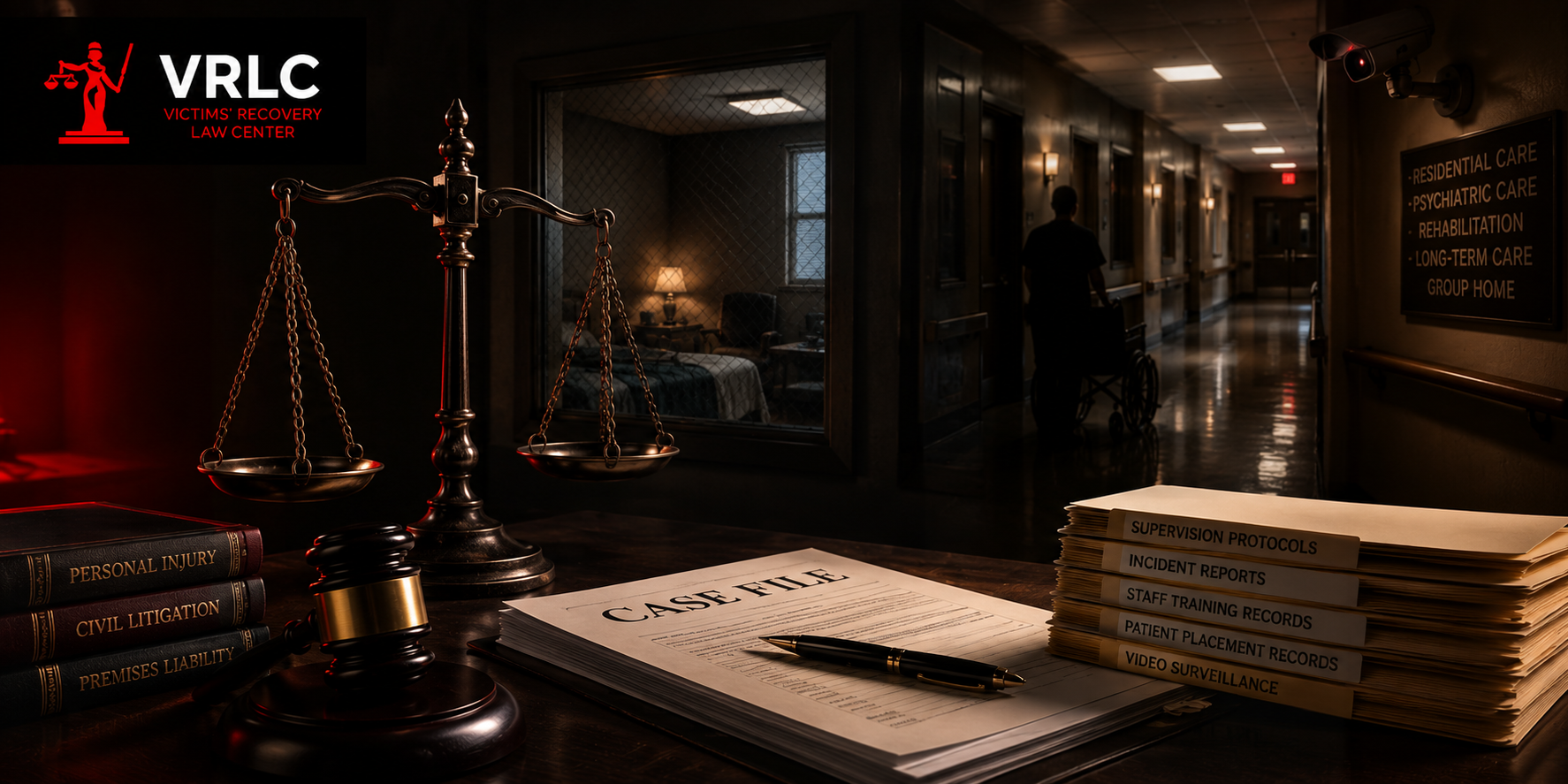
Civil discovery in residential care facility cases is among the most document intensive in civil litigation, and among the most revealing. Keith Thomas West and David P. Thiruselvam conduct thorough civil investigations that include obtaining patient supervision logs and incident reports, staff training and certification records, internal communications about known risks or prior complaints, administrative records showing patient placement decisions and the information available at the time, and video surveillance footage from the facility.
This institutional record frequently reveals a pattern of known deficiencies that the facility acknowledged internally and failed to address - documentation that is accessible through civil discovery and unavailable through any other legal mechanism. Where that record establishes that the facility knew of the specific risk that caused the catastrophic harm and failed to act, civil liability follows.
Preservation of this evidence is time critical. Residential care facilities maintain their own record retention schedules. Supervision logs, incident reports, and video footage are subject to possible destruction. The Victims' Recovery Law Center sends preservation notices to facilities immediately upon being retained, requiring retention of all potentially relevant records before they may be destroyed or overwritten.
Deliberate Indifference and the Falsification of Records
In government owned and operated residential care facility cases, the proof of institutional failure goes beyond negligence to deliberate indifference to potential harm. This is a very high bar and the proof may be contained in the records. There have been instances where safety patrol logs were falsified to show checks that were never conducted. In addition, incident reports may be suppressed or altered. Internal communications may be withheld. Where the civil investigation reveals evidence of record falsification or deliberate concealment of known safety failures, the strength of the civil claim against the facility is substantially enhanced.
The Victims' Recovery Law Center works with experienced forensic experts and investigators to identify discrepancies between official records and available video or witness evidence. Where falsification is discovered, it becomes central to the civil case - demonstrating not merely that the facility was negligent but that it was aware of its failures and chose to conceal rather than address them.
A Shooting Victim Civil Lawyer and Civil Lawyer for Crime Victims in Philadelphia and Pittsburgh
The Victims' Recovery Law Center's residential care facility practice is part of a broader civil litigation practice that represents shooting victims, sexual assault survivors, and child sexual assault victims across Philadelphia, Pittsburgh, Pennsylvania, New Jersey, and New York City. The firm brings the same approach to residential care facility civil claims that it applies in every practice area - identifying every legally responsible party and pursuing full financial accountability from each of them through civil litigation.
About The Victims' Recovery Law Center
Founded in 2007,The Victims' Recovery Law Center is a civil litigation firm based in Newtown Square, Pennsylvania. The firm's practice is limited to civil court representation of victims of crime. It does not prosecute criminal cases and does not represent criminal defendants. The firm's attorneys are shooting victim civil lawyers in Philadelphia, Pittsburgh, Pennsylvania, New Jersey, and New York City, and civil lawyers for rape and sexual assault victims across Philadelphia, Pittsburgh, Pennsylvania, New Jersey, and New York City, as well as civil lawyers for child sexual assault victims across all five markets.
David P. Thiruselvam is licensed to practice law in Pennsylvania, New York, and New Jersey and is a member of the Million Dollar Advocates Forum and the Multi-Million Dollar Advocates Forum. Attorney Keith Thomas West is licensed in Pennsylvania and New Jersey. For more information, visit victimrecoverylaw.com.
Frequently Asked Questions
Q: Can a patient or family sue a residential care facility in Philadelphia or Pittsburgh for negligent supervision?
Yes. Residential care facilities in Philadelphia, Pittsburgh, and across Pennsylvania operate under a legal duty to maintain reasonably safe conditions for patients in their care. Where a facility knew or should have known of a foreseeable risk and failed to take reasonable steps to address it through inadequate supervision, dangerous patient placement decisions, or ignored warning signs, civil liability may follow.
Q: What is deliberate indifference in a residential care facility civil case in Pennsylvania? Deliberate indifference is the legal standard required in civil cases for government owned and operated residential care facilities in Pennsylvania. It requires showing that the institution was aware of facts indicating a substantial risk of serious harm to a patient and recklessly and blatantly disregarded that risk by failing to take reasonable measures to address it. This standard applies to government owned and operated psychiatric hospitals, rehabilitation centers, group homes, and long-term care facilities across Philadelphia, Pittsburgh, Pennsylvania, and New Jersey..
Q: What evidence matters most in a residential care facility civil case in Philadelphia or Pittsburgh?
Patient supervision logs and incident reports, staff training and certification records, internal communications about known risks, patient placement documentation, and video surveillance footage are all critical. Preservation notices must be sent immediately as these records are subject to routine destruction on the facility's own schedule. The Victims' Recovery Law Center sends preservation notices to facilities upon being retained.
Q: Can a civil claim against a residential care facility succeed even if official records appear to show proper supervision?
Yes. Keith Thomas West and David P. Thiruselvam work with forensic experts and investigators to identify discrepancies between official records and available video or witness evidence. Where record falsification is discovered - supervision logs showing checks that were never conducted, incident reports that were suppressed - it becomes central to the civil case and substantially strengthens the claim against the facility.
Q: How long do patients and families have to file a civil lawsuit against a residential care facility in Pennsylvania?
Pennsylvania's statute of limitations for personal injury and wrongful death claims is generally two years from the date of the harm or death. This deadline applies in Philadelphia, Pittsburgh, and across Pennsylvania, and New Jersey, and is strictly enforced. Patients and families are well advised to consult a civil attorney as early as possible to preserve supervision logs, incident reports, and video footage before they are destroyed.
Media Contact
Jack Smith
Media Director
Trustpoint Xposure
[email protected]
SOURCE: Victims' Recovery Law Center