




Monday, 18 May 2026 01:35 AM
Company Update
Odor-scavenging masterbatches accelerate low-odor recycled polyolefin packaging, enabling cleaner PCR adoption, compliance, and consumer-ready sustainability.
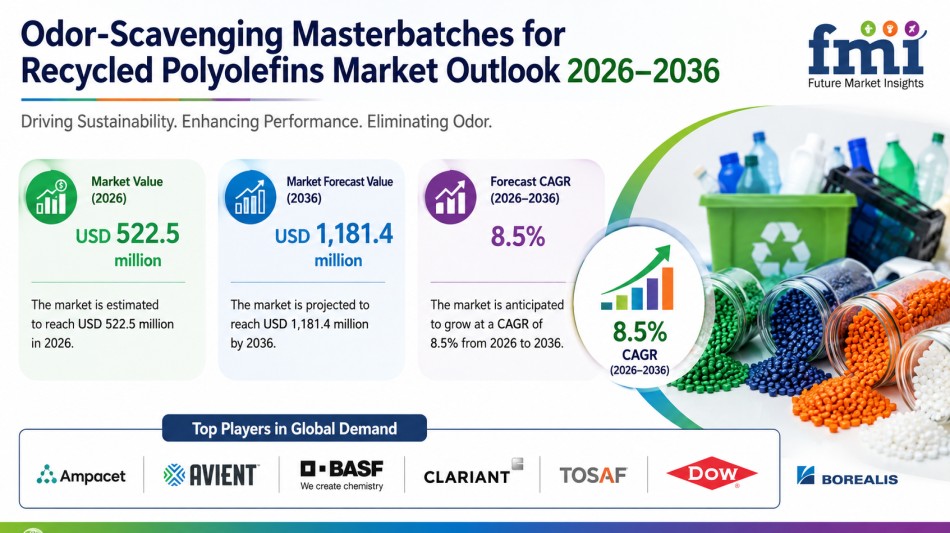
NEWARK, DE / ACCESS Newswire / May 18, 2026 / According to the latest market analysis by Future Market Insights, the odor-scavenging masterbatches for recycled polyolefins market is transitioning from a niche additive segment into a critical enabling technology for recycled plastic packaging adoption. Valued at USD 481.6 million in 2025 and projected to reach USD 522.5 million in 2026, the market is set to expand at a CAGR of 8.5%, ultimately reaching USD 1,181.4 million by 2036.
This growth reflects a structural shift in recycled plastics manufacturing moving beyond recycled-content targets toward performance-qualified, consumer-acceptable recycled packaging systems.
Quick Stats at a Glance
Market size (2025): USD 481.6 million
Estimated value (2026): USD 522.5 million
Forecast (2036): USD 1,181.4 million
CAGR (2026-2036): 8.5%
Incremental opportunity: USD 658.9 million
Leading form: Pellet masterbatch (71.0% share)
Top sales channel: Direct sales (68.0% share)
Dominant carrier resin: Recycled PE (57.0% share)
Leading application: Flexible packaging (39.0% share)
Leading end use: Packaging converters (44.0% share)
Fastest-growing markets: India (11.4%), China (10.2%), Brazil (8.8%)
Get detailed market forecasts, competitive benchmarking, and pricing trends:
https://www.futuremarketinsights.com/reports/sample/rep-gb-33129
Market Size and Structural Shift
The odor-scavenging masterbatches for recycled polyolefins market is entering a sustained expansion phase as recycled polyethylene (PE) and polypropylene (PP) move deeper into consumer-facing packaging applications.
However, the market's evolution is being driven less by additive volumes and more by quality qualification requirements.
Historically, recycled plastics adoption focused primarily on recycled-content percentages and material cost advantages. That model is changing. Brand owners and packaging converters increasingly recognize that odor contamination-caused by residual detergents, fragrances, food waste, and mixed post-consumer streams can undermine consumer acceptance even when recycled resin meets mechanical specifications.
Odor-scavenging masterbatches address this challenge by neutralizing or trapping volatile compounds inside recycled polymer matrices, enabling recycled plastics to meet stricter sensory expectations in packaging, consumer goods, and automotive applications.
As a result, odor control is becoming a commercial gatekeeper for high-value recycled resin adoption.
Growth Drivers: Regulation, Consumer Acceptance, and PCR Expansion
Three major forces are accelerating global adoption.
1. Recycled Content Regulations
Governments are moving recycled-content targets from voluntary sustainability goals into enforceable packaging standards.
The European Union's Packaging and Packaging Waste Regulation (PPWR), which entered into force in February 2025, is increasing pressure on packaging suppliers to use recyclable and recycled-content materials across product portfolios.
Similarly, the United Kingdom's Plastic Packaging Tax penalizes packaging containing less than 30% recycled content, increasing the cost of failed PCR qualification programs.
These policy shifts are driving demand for additives that improve recycled resin usability and approval rates.
2. Consumer Sensory Expectations
As recycled plastics move into personal care, household, and food-adjacent packaging, odor performance has become a consumer-facing issue.
Even when recycled PE or PP passes melt-flow and structural testing, residual odors can trigger brand rejection or customer complaints. Packaging converters are increasingly using odor-control concentrates to stabilize recycled resin performance before commercial rollout.
3. Flexible Packaging Growth
Flexible packaging remains one of the largest growth areas for recycled polyolefins, but thin films expose odor variability more quickly than rigid formats.
Film converters are adopting odor-scavenging masterbatches to support recycled-content expansion in pouches, overwraps, and household packaging while protecting product perception and shelf appeal.
Market Constraints: Feedstock Variability and Qualification Complexity
Despite strong momentum, adoption challenges remain significant.
Post-consumer recycled (PCR) streams vary widely in contamination levels, creating inconsistent odor profiles across resin batches. This variability complicates converter qualification and increases production risk.
Operational integration also remains complex. Additive suppliers must ensure odor reduction without negatively affecting melt flow, mechanical performance, color stability, or food-contact compliance.
High-performance odor-control systems frequently require resin-specific formulations, plant trials, and dosage optimization, increasing both technical requirements and customer support expectations.
In practice, odor management is becoming less of a commodity additive function and more of a technical service-driven market.
Opportunity Landscape: Where Value Creation Is Emerging
Several high-impact opportunities are shaping the next phase of market growth:
Low-odor recycled packaging for personal care and household applications
Hybrid additive systems combining odor control, stabilization, and compatibilization
Resin-specific scavenger systems optimized for recycled PE and PP streams
Food-contact compliant recycled polyolefin compounds
Flexible packaging applications using higher PCR loading rates
Regional recycler partnerships supporting feedstock-specific odor management
As packaging brands scale recycled-content programs, suppliers capable of delivering measurable odor-reduction performance and technical trial support are expected to gain competitive advantage.
Speak to Analyst: Customize insights for your business strategy:
https://www.futuremarketinsights.com/customization-available/rep-gb-33129
Segment Insights: Where the Market Is Concentrated
By Form: Pellet masterbatch dominates with a 71.0% share in 2026, driven by converters seeking easier dosing, cleaner handling, and compatibility with existing extrusion and molding systems.
By Sales Channel: Direct sales lead with a 68.0% share, reflecting the technical complexity of recycled resin qualification programs. Large buyers increasingly require supplier-led plant trials, dosage guidance, and ongoing process support.
By Carrier Resin: Recycled PE holds the largest share at 57.0%, supported by widespread PCR usage across films and flexible packaging applications.
By Active Mechanism: Adsorptive scavengers account for 42.0% share in 2026, favored for their ability to trap volatile compounds without major process modifications.
By Application: Flexible packaging leads with 39.0% share, as odor sensitivity is more pronounced in thin-film packaging structures than in thicker molded products.
Regional Dynamics: Growth Is Accelerating Across Packaging Hubs
Global adoption patterns vary according to recycling infrastructure, packaging regulations, and converter quality requirements.
India (11.4% CAGR) India is emerging as the fastest-growing market, driven by extended producer responsibility (EPR) regulations, recycler investments, and rising demand for cleaner PCR packaging materials.
China (10.2% CAGR) China's large packaging conversion base and expanding recycled polyolefin compounding capacity are accelerating demand for odor-management solutions across flexible packaging and molded goods.
Brazil (8.8% CAGR) Consumer goods packaging expansion and growing PCR trials are increasing the need for odor-control additives in PE and PP packaging applications.
United States (8.1% CAGR) Recycling infrastructure investments and aggressive brand sustainability targets are supporting wider adoption of recycled-content packaging and odor-scavenging technologies.
Germany (7.4% CAGR) Germany's mature recycling systems and strict packaging quality expectations are driving demand for low-odor recycled polyolefin compounds with consistent sensory performance.
Competitive Landscape: Technical Support Becomes a Differentiator
The competitive environment is shifting from simple additive supply toward integrated recyclate performance support.
Key companies including Ampacet, Avient, BASF, Clariant, Tosaf, Dow, and Borealis-are increasingly competing on:
Resin-specific odor reduction chemistry
PCR compatibility performance
Converter trial support and technical services
Food-contact compliance documentation
Carrier-resin optimization
Faster sampling and formulation customization
Regional players such as Plastiblends, Kingfa, and Ganga Masterbatches are competing through faster response cycles, lower order volumes, and localized converter support.
For buyers, supplier selection increasingly depends on repeatable odor reduction performance across real-world recycled feedstock conditions.
Strategic Implications for Industry Stakeholders
For recyclers and compounders, odor control is becoming essential for moving recycled resins into higher-value consumer packaging segments.
For packaging converters, odor-scavenging masterbatches reduce complaint risk and improve the commercial viability of PCR films and molded products.
For brand owners, sensory acceptance is emerging as a critical factor in sustainable packaging adoption and consumer trust.
For investors, the market offers recurring revenue potential through additive supply, technical services, and formulation support tied to expanding recycled-content mandates.
For procurement leaders, supplier evaluation is shifting beyond additive pricing toward reliability, compliance support, and recyclate qualification capabilities.
Future Outlook: From Additive Function to Packaging Qualification Infrastructure
Over the next decade, odor-scavenging masterbatches are expected to evolve from standalone additives into integrated recycled-polyolefin qualification systems.
Key trends to watch include:
Wider adoption of hybrid odor-control and stabilization packages
Increased use of VOC and carbonyl testing for performance validation
Expansion of food-contact compliant recycled polyolefin grades
Integration of odor management into recyclate quality certification systems
Greater collaboration between recyclers, compounders, and packaging converters
As recycled-content requirements become stricter worldwide, odor control will increasingly define which recycled plastics can successfully move into premium consumer packaging applications.
Unlock 360° insights for strategic decision making and investment planning-
https://www.futuremarketinsights.com/checkout/33129
Executive Takeaways
Odor-scavenging masterbatches are evolving into a critical enabling technology for recycled polyolefin adoption.
Regulatory pressure and recycled-content mandates are accelerating demand globally.
Flexible packaging and personal care applications are creating the strongest pull for low-odor recycled resins.
Feedstock variability and qualification complexity remain key operational challenges.
Competitive advantage is shifting toward technical support, resin compatibility, and measurable odor-reduction performance.
The next phase of market growth will be driven by integrated recyclate qualification ecosystems rather than additive volumes alone.
Related Reports:
Recycled PET Packaging Market: https://www.futuremarketinsights.com/reports/recycled-pet-market
Recycled Polyethylene Terephthalate (rPET) Market: https://www.futuremarketinsights.com/reports/recycled-polyethylene-terephthalate-packaging-market
Recycled Polyolefin Compounds for Food Packaging Market: https://www.futuremarketinsights.com/reports/recycled-polyolefin-compounds-for-food-packaging-market
Recycled Plastic Packaging Market: https://www.futuremarketinsights.com/reports/recycled-plastic-packaging-market
Recycled Ocean Plastic Packaging Market: https://www.futuremarketinsights.com/reports/recycled-ocean-plastic-packaging-market
About Future Market Insights (FMI)
Future Market Insights (FMI) is a leading provider of market intelligence and consulting services, serving clients in over 150 countries. Headquartered in Delaware, USA, with a global delivery center in India and offices in the UK and UAE, FMI delivers actionable insights to businesses across industries including automotive, technology, consumer products, manufacturing, energy, and chemicals.
An ESOMAR-certified research organization, FMI provides custom and syndicated market reports and consulting services, supporting both Fortune 1,000 companies and SMEs. Its team of 300+ experienced analysts ensures credible, data-driven insights to help clients navigate global markets and identify growth opportunities.
For Press & Corporate Inquiries
Rahul Singh
AVP - Marketing and Growth Strategy
Future Market Insights, Inc.
+91 8600020075
For Sales - [email protected]
For Media - [email protected]
For Web - https://www.futuremarketinsights.com/
For Web - https://www.factmr.com/
SOURCE: Future Market Insights, Inc.