



Wednesday, 20 May 2026 03:05 AM
Company Update
Industrial plastic bags are evolving into strategic industrial supply solutions supporting manufacturing efficiency, logistics resilience, compliance, and infrastructure growth globally.
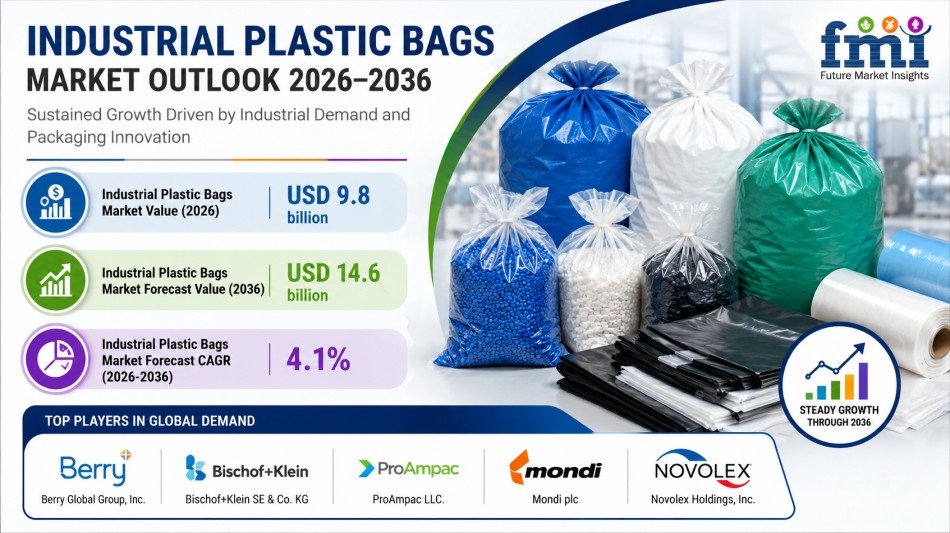
NEWARK, DE / ACCESS Newswire / May 20, 2026 / According to the latest market analysis by Future Market Insights, the industrial plastic bags market is evolving from a traditional packaging procurement category into a strategic industrial supply solution supporting modern manufacturing, logistics, and infrastructure operations. Valued at USD 9.4 billion in 2025 and projected to reach USD 9.8 billion by 2026, the market is expected to expand at a CAGR of 4.1% during the forecast period, ultimately reaching USD 14.6 billion by 2036.
This growth reflects a broader transformation in industrial procurement patterns, where manufacturers increasingly prioritize operational efficiency, regulatory compliance, supply reliability, and cost optimization across packaging and material handling systems.
Quick Stats at a Glance
Market size (2025): USD 9.4 billion
Estimated value (2026): USD 9.8 billion
Forecast (2036): USD 14.6 billion
CAGR (2026-2036): 4.1%
Incremental opportunity: USD 4.8 billion
Leading material segment: Polyethylene (PE) (45.2% share)
Leading capacity segment: 20 to 50 kg (40.9% share)
Leading growth market: India (6.0% CAGR)
Major regional market: Europe
Leading company: Berry Global Group, Inc. (21.9% estimated market share)
Get detailed market forecasts, competitive benchmarking, and pricing trends:
https://www.futuremarketinsights.com/reports/sample/rep-gb-5548
Market Size and Structural Shift
The industrial plastic bags market is entering a long-term expansion phase as industrial sectors modernize production facilities, strengthen logistics operations, and improve material handling efficiency.
Historically, industrial plastic bags were treated as low-priority consumables purchased primarily on price. That dynamic is shifting. Today, industrial buyers increasingly view packaging reliability, durability, compliance, and supply continuity as operational necessities rather than secondary procurement considerations.
The transition is especially visible across manufacturing, chemicals, agriculture, pharmaceuticals, construction, and retail logistics sectors, where packaging performance directly impacts operational efficiency, inventory protection, workplace safety, and transportation reliability.
As supply chains become more integrated and production networks expand globally, industrial plastic bags are becoming a more strategic component of industrial infrastructure planning.
Growth Drivers: Industrial Expansion, Compliance, and Infrastructure Investment
Three major forces are accelerating market demand globally.
1. Industrial Capacity Expansion
Manufacturing growth and facility modernization programs are increasing procurement demand for industrial packaging products. Expanding factories, warehouses, and processing facilities require durable and scalable packaging systems that support higher operational throughput.
2. Regulatory and Compliance Requirements
Tightening environmental, workplace safety, and material handling regulations are creating compliance-driven demand for industrial plastic bags that meet updated standards for strength, containment, labeling, and waste management.
3. Supply Chain Restructuring and Nearshoring
Companies are redesigning supply chains to improve resilience and reduce transportation risk. Nearshoring strategies and localized manufacturing expansion are driving investment in industrial packaging infrastructure across regional production hubs.
Market Constraints: Pricing Pressure and Raw Material Volatility
Despite steady growth, the market faces several operational and commercial challenges.
Raw material cost volatility remains one of the biggest concerns for manufacturers. Fluctuating resin prices and supply concentration risks continue to pressure profit margins, particularly during periods of global supply disruption.
At the same time, industrial procurement teams remain highly price-sensitive. Large institutional buyers increasingly consolidate purchasing contracts, creating intense competition among suppliers and limiting premium pricing opportunities.
Manufacturers must therefore balance cost efficiency with product quality, compliance, and supply reliability to maintain competitiveness.
Opportunity Landscape: Where Future Growth Is Emerging
Several strategic opportunities are shaping the next phase of market development:
Sustainable and recycled plastic solutions: Growing environmental pressure is accelerating adoption of recyclable and biodegradable industrial bag materials.
Infrastructure development in emerging economies: Industrial expansion in India, China, and Southeast Asia is creating large-scale procurement demand.
Specialized industrial applications: Demand for application-specific bags in chemicals, pharmaceuticals, and hazardous materials handling is increasing.
E-commerce and logistics growth: Expanding warehouse and fulfillment operations are driving demand for durable industrial packaging products.
Customization and performance optimization: Buyers increasingly seek tailored specifications for strength, durability, and operational compatibility.
Speak to Analyst: Customize insights for your business strategy:
https://www.futuremarketinsights.com/customization-available/rep-gb-5548
Segment Insights: Where the Market Is Concentrated
By Material
Polyethylene (PE) dominates the material segment with a 45.2% market share in 2026. Its leadership is supported by cost efficiency, durability, flexibility, and compatibility across multiple industrial applications.
PE remains widely preferred due to its proven performance characteristics and broad adoption across manufacturing and logistics operations.
By Capacity
The 20 to 50 kg segment accounts for 40.9% of the market, reflecting widespread use across industrial packaging, transportation, and storage applications.
Demand remains concentrated in industries requiring standardized medium-capacity packaging for bulk materials, industrial products, and supply chain handling.
Regional Dynamics: Growth Remains Strongest in Emerging Markets
Market expansion varies significantly across regions based on industrial activity, infrastructure investment, and regulatory conditions.
India (6.0% CAGR): India leads global growth, supported by infrastructure expansion, industrial modernization, and increasing adoption across manufacturing and logistics sectors. Government investment initiatives are further accelerating packaging demand.
China (5.2% CAGR): China continues to expand through industrial infrastructure investment and manufacturing modernization. Regulatory compliance requirements are also supporting procurement of upgraded industrial packaging solutions.
Canada (4.0% CAGR): Canada's growth is supported by replacement demand, operational modernization, and institutional procurement across established industrial sectors.
Germany (3.8% CAGR): Germany remains a stable industrial market driven by modernization programs, advanced manufacturing operations, and compliance-focused procurement standards.
USA (3.3% CAGR): In the United States, demand is supported by industrial replacement cycles, infrastructure upgrades, and continued growth across logistics and warehousing sectors.
Competitive Landscape: Scale and Reliability Define Leadership
The competitive environment is increasingly shaped by manufacturing scale, distribution strength, and supply reliability.
Key companies including Berry Global Group, Inc., Bischof+Klein SE & Co. KG, ProAmpac LLC., Mondi plc, and Novolex Holdings, Inc. are increasingly competing on:
Product performance and durability
Large-scale manufacturing capability
Long-term institutional supply agreements
Regional distribution networks
Regulatory compliance expertise
Reliable delivery and service support
Berry Global Group, Inc. currently leads the market with an estimated 21.9% share, supported by broad product coverage, global production capacity, and established procurement relationships.
Strategic Implications for Industry Stakeholders
For manufacturers, the market is shifting toward higher operational expectations around quality consistency, compliance, and supply continuity.
For procurement leaders, supplier evaluation increasingly extends beyond price to include service reliability, material availability, and long-term operational value.
For investors, recurring demand across industrial sectors provides relatively stable long-term growth opportunities, particularly in sustainable packaging and emerging market expansion.
For distributors and converters, regional supply chain optimization and customized product offerings are becoming important competitive differentiators.
Future Outlook: From Commodity Packaging to Strategic Industrial Supply
Over the next decade, industrial plastic bags are expected to evolve from commoditized packaging products into more specialized industrial supply solutions integrated into broader logistics and operational systems.
Key trends likely to shape the market include:
Increased adoption of recyclable and biodegradable materials
Greater focus on supply chain resilience and regional sourcing
Expansion of customized industrial packaging solutions
Integration of compliance-driven product specifications
Growth of automated manufacturing and packaging systems
As industrial operations become more efficiency-driven and compliance-focused, demand for reliable, scalable, and application-specific packaging products will continue to strengthen.
Unlock 360° insights for strategic decision making and investment planning-
https://www.futuremarketinsights.com/checkout/5548
Executive Takeaways
Industrial plastic bags are evolving into a more strategic industrial procurement category.
Infrastructure investment and manufacturing expansion remain the primary growth drivers.
Regulatory compliance requirements are accelerating adoption of higher-performance packaging solutions.
Raw material volatility and pricing pressure remain key industry challenges.
Competitive advantage is increasingly defined by manufacturing scale, supply reliability, and operational service quality.
Emerging markets, particularly India and China, will remain central to future market expansion.
Related Reports:
Bioplastic Packaging Bag Market: https://www.futuremarketinsights.com/reports/bioplastic-packaging-bag-market
Circular Industrial Bags Market: https://www.futuremarketinsights.com/reports/circular-industrial-bags-market
Plastic Vials and Ampoules Market: https://www.futuremarketinsights.com/reports/plastic-vials-and-ampoules-market
Plastic Sterilization Trays Market: https://www.futuremarketinsights.com/reports/plastic-sterilization-trays-market
Plastic Bag Market: https://www.futuremarketinsights.com/reports/plastic-bag-market
About Future Market Insights (FMI)
Future Market Insights (FMI) is a leading provider of market intelligence and consulting services, serving clients in over 150 countries. Headquartered in Delaware, USA, with a global delivery center in India and offices in the UK and UAE, FMI delivers actionable insights to businesses across industries including automotive, technology, consumer products, manufacturing, energy, and chemicals.
An ESOMAR-certified research organization, FMI provides custom and syndicated market reports and consulting services, supporting both Fortune 1,000 companies and SMEs. Its team of 300+ experienced analysts ensures credible, data-driven insights to help clients navigate global markets and identify growth opportunities.
For Press & Corporate Inquiries
Rahul Singh
AVP - Marketing and Growth Strategy
Future Market Insights, Inc.
+91 8600020075
For Sales - [email protected]
For Media - [email protected]
For Web - https://www.futuremarketinsights.com/
For Web - https://www.factmr.com/
SOURCE: Future Market Insights, Inc.