




Friday, 22 May 2026 08:35 AM
Company Update
Rising demand for satellite-based connectivity, aircraft retrofit programs, real-time digital aviation services, and high-speed onboard broadband is accelerating growth across the global in-flight internet market through 2036.
NEWARK, DE / ACCESS Newswire / May 22, 2026 / According to the latest market analysis by Future Market Insights, the global in-flight internet market is entering a more connectivity-centric growth phase as airlines increasingly prioritize passenger digital experience, real-time operational communication, and connected aircraft infrastructure across commercial aviation networks.
The market is evolving from a passenger convenience feature into a strategic aviation connectivity ecosystem where airlines, connectivity providers, and aircraft operators increasingly focus on high-speed broadband performance, satellite coverage reliability, retrofit scalability, and integrated digital service capability before expanding onboard connectivity programs.
Quick Stats Snapshot
Global market value (2025): USD 1.7 billion
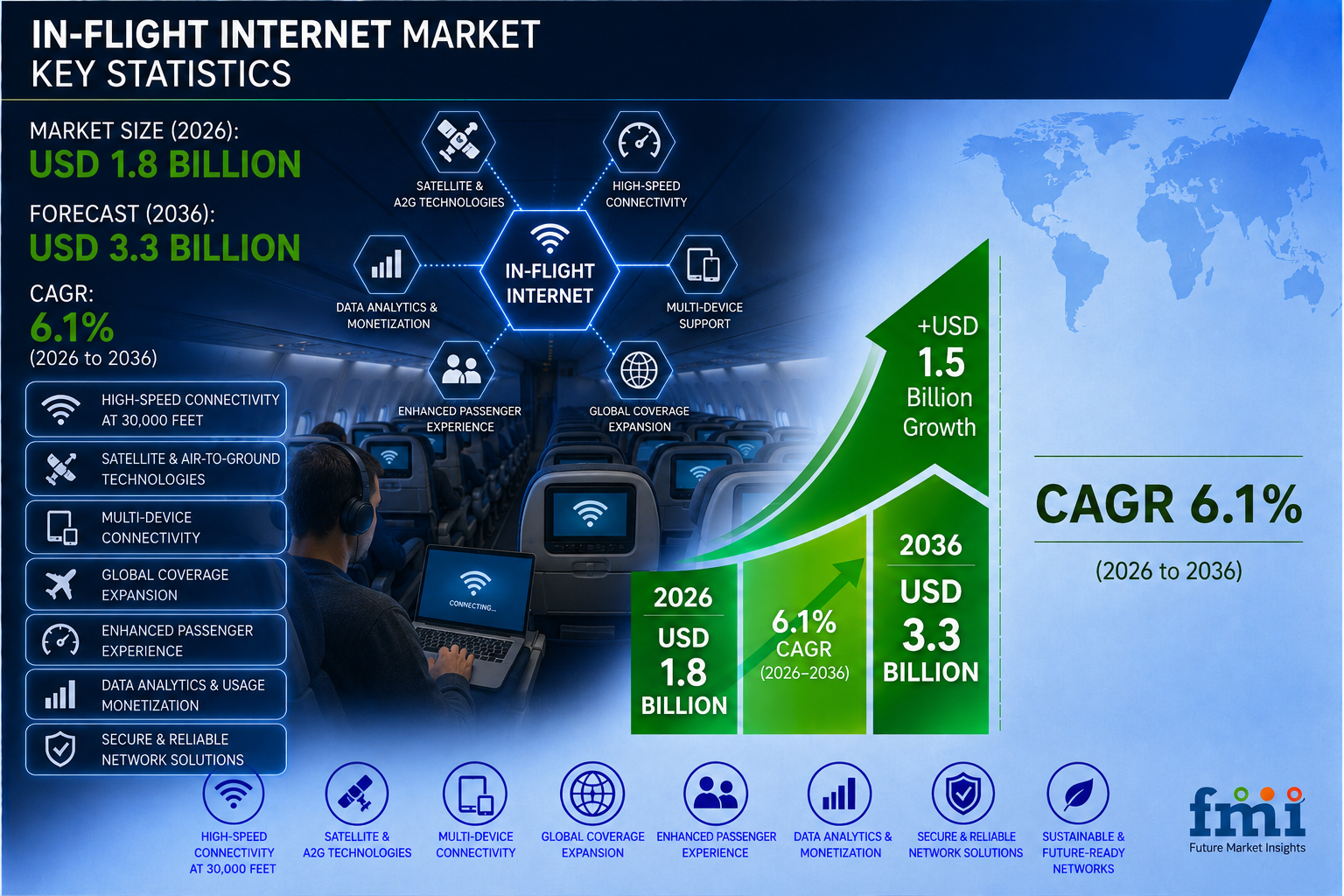
Estimated market value (2026): USD 1.8 billion
Forecast market value (2036): USD 3.3 billion
Global market CAGR (2026-2036): 6.1%
Leading connectivity type: Satellite-based Connectivity (45.8% share)
Leading technology segment: Satellite Broadband (31.8% share)
Leading connectivity speed segment: High Speed (48.2% share)
Top growth market: China (8.2% CAGR)
Fast-growing emerging market: India (7.6% CAGR)
Leading company: Viasat, Inc.
Get detailed market forecasts, competitive benchmarking, and pricing trends:
https://www.futuremarketinsights.com/reports/sample/rep-gb-25811
Market Outlook: Connected Aircraft Infrastructure and Passenger Expectations Support Long-Term Growth
The in-flight internet market is projected to witness sustained expansion through 2036 as airlines, aviation connectivity providers, aircraft OEMs, and fleet operators increasingly prioritize onboard broadband systems capable of supporting passenger streaming, operational communication, cockpit connectivity, and digital aviation services.
Satellite-based connectivity solutions continue dominating commercial demand because they provide wider geographic coverage, scalable deployment capability, and stronger compatibility with long-haul international flight operations. Airlines are simultaneously increasing retrofit and line-fit installation programs as passengers increasingly expect uninterrupted onboard digital access across both premium and economy travel segments.
At the same time, growing demand for connected aircraft ecosystems, real-time fleet monitoring, and digital passenger engagement is creating additional commercial momentum across global aviation markets.
The category is increasingly positioned as a strategic aviation infrastructure segment supporting passenger satisfaction, operational efficiency, digital airline transformation, and connected aircraft modernization.
Growth Drivers: Passenger Connectivity Expectations and Aviation Digitalization Accelerate Market Growth
Several structural factors are supporting market expansion:
1. Passenger Demand for Continuous Connectivity Expands Deployment
Air travelers increasingly expect high-speed internet access for streaming, messaging, business communication, and digital entertainment throughout flights.
2. Satellite Connectivity Infrastructure Improves Coverage
Advancements in satellite broadband technology are improving onboard connectivity reliability, bandwidth performance, and geographic service availability.
3. Aircraft Retrofit Programs Support Connectivity Expansion
Airlines continue retrofitting older aircraft with onboard internet capability as fleet modernization strategies increasingly prioritize passenger experience enhancement.
4. Connected Aircraft Ecosystems Strengthen Operational Efficiency
Airlines are integrating connectivity systems into broader digital aviation platforms supporting predictive maintenance, operational analytics, and real-time aircraft communication.
Key Challenges: Infrastructure Costs and Bandwidth Management Remain Critical
Despite favorable growth prospects, the industry continues facing several operational and commercial challenges:
High aircraft connectivity installation costs
Satellite bandwidth pricing pressures
Regulatory approvals across international airspace
Connectivity reliability during peak traffic conditions
Aircraft retrofit downtime constraints
Data security and cybersecurity compliance requirements
Companies capable of combining reliable broadband infrastructure, scalable satellite coverage, cybersecurity capability, and lower operational costs are expected to strengthen competitive positioning across global aviation markets.
Emerging Opportunities: High-Speed Broadband and Hybrid Connectivity Expand Commercial Potential
Key opportunities are centered around connected aircraft modernization and digital passenger engagement:
Expansion of high-speed in-flight streaming capability
Increasing adoption of hybrid connectivity architectures
Rising retrofit demand across narrow-body aircraft fleets
Growth in premium airline digital service offerings
Greater investment in low-earth-orbit satellite networks
Increasing integration of AI-enabled passenger personalization systems
Segmentation Insights: Satellite-Based Connectivity and Broadband Services Dominate Demand
By Connectivity Type
Satellite-based connectivity is forecast to capture 45.8% share in 2026 as airlines increasingly prioritize global coverage capability and scalable onboard internet deployment.
By Technology
Satellite broadband is projected to account for 31.8% share in 2026 due to established procurement patterns and growing demand for high-capacity aviation data transmission.
By Connectivity Speed
High-speed connectivity is expected to represent 48.2% share during the forecast period as passengers increasingly demand streaming-quality onboard internet performance.
By Installation Type
Retrofit programs continue expanding as airlines modernize existing fleets with connected aircraft infrastructure and passenger broadband systems.
By Service Model
Freemium and paid Wi-Fi models continue shaping airline monetization strategies as carriers balance passenger engagement with onboard connectivity revenue generation.
Customize insights for your business strategy:
https://www.futuremarketinsights.com/customization-available/rep-gb-25811
Regional Analysis: China and India Lead Connectivity Expansion
China (8.2% CAGR)
China remains the leading growth market supported by aviation infrastructure investment, rapid airline fleet expansion, and increasing passenger demand for onboard digital services.
India (7.6% CAGR)
India continues benefiting from expanding domestic aviation traffic, rising airline digitalization initiatives, and growing retrofit activity across commercial fleets.
Germany (7.0% CAGR)
Germany supports strong market demand through aviation technology leadership, connected aircraft modernization, and regulatory-standardized digital aviation infrastructure.
France (6.4% CAGR)
France continues benefiting from aerospace connectivity innovation and increasing investment in commercial aircraft digital systems.
United Kingdom (5.8% CAGR)
The UK market remains supported by mature aviation connectivity adoption and growing airline investment in passenger digital engagement systems.
United States (5.2% CAGR)
The United States market continues benefiting from advanced aviation infrastructure, large installed aircraft fleets, and strong airline competition around passenger connectivity services.
Asia-Pacific markets are expected to outperform mature aviation regions due to stronger passenger growth, rapid airline expansion, and increasing aviation digital infrastructure investment.
Competitive Landscape: Broadband Capability and Multi-Regional Coverage Shape Competition
The in-flight internet market remains moderately concentrated, with satellite connectivity providers, aviation communication specialists, and aircraft integration companies competing across commercial aviation connectivity programs.
Key companies include:
Viasat, Inc.
Panasonic Avionics Corporation
Gogo Business Aviation LLC.
Deutsche Telekom AG
Lufthansa Technik
Leading suppliers continue strengthening market position through satellite network expansion, integrated aviation connectivity platforms, multi-regional distribution capability, and aircraft retrofit expertise.
Analyst Opinion
Industry analysts observe that the in-flight internet market is transitioning from volume-led deployment toward specification-driven aviation connectivity sourcing. Airlines increasingly prioritize suppliers capable of delivering regulatory compliance, scalable broadband performance, cybersecurity protection, and cost-efficient connectivity infrastructure across global flight operations.
Strategic Implications for Industry Leaders
For airlines, connectivity providers, aircraft OEMs, and aviation infrastructure companies, the market presents several strategic priorities:
Satellite-based connectivity remains central to aircraft internet deployment
High-speed broadband is becoming a core passenger experience expectation
Retrofit installation programs continue supporting market expansion
Cybersecurity compliance is becoming increasingly important
Connected aircraft ecosystems support operational efficiency gains
Multi-regional satellite coverage shapes supplier competitiveness
AI-enabled passenger engagement creates additional service opportunities
Future Outlook: From Passenger Wi-Fi Feature to Connected Aviation Infrastructure Ecosystem
The in-flight internet market is expected to evolve beyond a passenger convenience feature into a more operationally integrated ecosystem focused on connected aircraft intelligence, real-time aviation communication, digital passenger services, and scalable broadband infrastructure.
Key trends expected to shape the market include:
Expansion of low-earth-orbit satellite connectivity deployment
Greater investment in high-speed aviation broadband systems
Rising integration of AI-powered passenger personalization platforms
Increasing airline adoption of hybrid connectivity architectures
Stronger focus on connected aircraft operational analytics
Continued growth in retrofit connectivity modernization programs
Unlock 360° insights for strategic planning and investment decisions:
https://www.futuremarketinsights.com/checkout/25811
Executive Takeaways
Satellite-based connectivity continues dominating aircraft internet deployment
Satellite broadband remains the leading technology segment
High-speed internet demand is reshaping passenger experience expectations
China and India are leading aviation connectivity growth momentum
Retrofit programs continue supporting connected aircraft expansion
Cybersecurity and bandwidth management shape supplier competitiveness
Digital aviation transformation is accelerating connectivity investment
Connected aircraft ecosystems are becoming central to airline modernization strategies
As airlines continue prioritizing passenger digital engagement, operational connectivity, and connected aircraft infrastructure, companies capable of combining scalable broadband capability, reliable satellite coverage, cybersecurity compliance, and cost-efficient deployment models will be best positioned to capitalize on long-term in-flight internet market growth.
Related Reports:
Internet of Everything (IoE) Market - https://www.futuremarketinsights.com/reports/global-internet-of-everything-market
Internet Protocol Television Market - https://www.futuremarketinsights.com/reports/internet-protocol-television-market
Internet Of Things In Farm Management Market - https://www.futuremarketinsights.com/reports/internet-of-things-in-farm-management-market
Internet Security Market - https://www.futuremarketinsights.com/reports/internet-security-market
Internet Of Things IoT Monetization Market - https://www.futuremarketinsights.com/reports/internet-of-things-iot-monetization-market
About Future Market Insights (FMI)
Future Market Insights (FMI) is a leading provider of market intelligence and consulting services, serving clients in over 150 countries. Headquartered in Delaware, USA, with a global delivery center in India and offices in the UK and UAE, FMI delivers actionable insights to businesses across industries including automotive, technology, consumer products, manufacturing, energy, and chemicals.
An ESOMAR-certified research organization, FMI provides custom and syndicated market reports and consulting services, supporting both Fortune 1,000 companies and SMEs. Its team of 300+ experienced analysts ensures credible, data-driven insights to help clients navigate global markets and identify growth opportunities.
For Press & Corporate Inquiries:
Rahul Singh
AVP - Marketing and Growth Strategy
Future Market Insights, Inc.
+91 8600020075
For Sales - [email protected]
For Media - [email protected]
For Web - https://www.futuremarketinsights.com/
For Web - https://www.factmr.com/
SOURCE: Future Market Insights, Inc.