



Friday, 15 May 2026 02:00 AM
Company Update
Flexible plastic packaging transforms lightweight, recyclable, high-barrier solutions for food, pharma, and personal care supply chain efficiency.
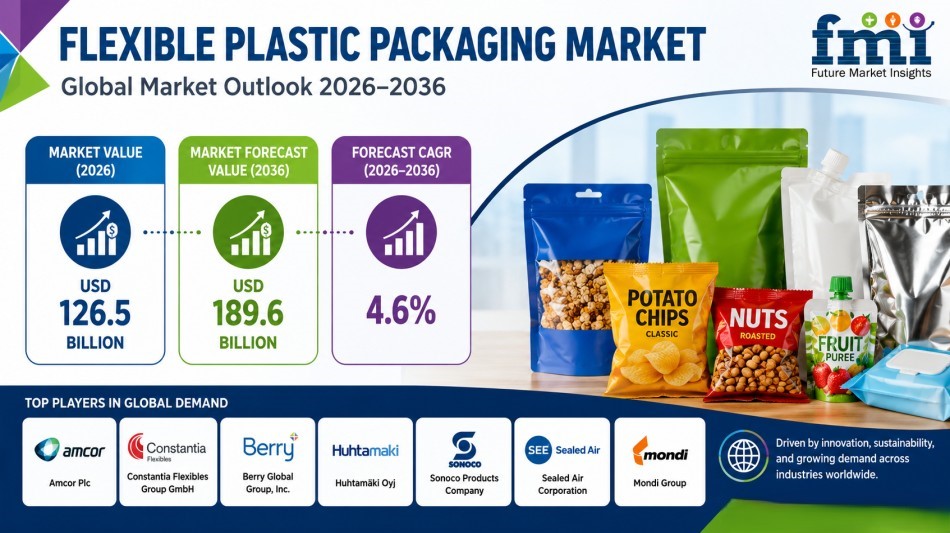
NEWARK, DE / ACCESS Newswire / May 15, 2026 / According to the latest market analysis by Future Market Insights, the flexible plastic packaging market is transitioning from a cost-focused packaging format into a strategic material platform supporting shelf-life extension, lightweighting, and recycling compliance across food, pharmaceutical, and personal care industries. Valued at USD 120.9 billion in 2025 and projected to reach USD 126.5 billion in 2026, the market is expected to expand at a CAGR of 4.6%, ultimately reaching USD 189.6 billion by 2036.
This growth reflects a structural shift in packaging priorities-moving away from rigid, material-intensive formats toward lightweight flexible structures designed for performance, logistics efficiency, and evolving sustainability requirements.
Quick Stats at a Glance
Market size (2025): USD 120.9 billion
Estimated value (2026): USD 126.5 billion
Forecast (2036): USD 189.6 billion
CAGR (2026-2036): 4.6%
Incremental opportunity: USD 63.1 billion
Leading product segment: Films and wraps (36.8% share)
Dominant material: Oil-based polymers (58.0% share)
Key packaging format: Modified atmospheric packaging (45.8% share)
Leading application: Pharmaceutical packaging (42.0% share)
Fastest-growing market: India (7.0% CAGR)
Major growth regions: East Asia, South Asia, and North America
Get detailed market forecasts, competitive benchmarking, and pricing trends:
https://www.futuremarketinsights.com/reports/sample/rep-gb-4174
Market Size and Structural Shift
The flexible plastic packaging market is entering a long-term expansion phase, supported by changing packaging economics and growing demand for lighter, high-performance materials.
Traditional rigid packaging formats increase transportation weight, storage space, and material consumption. Flexible packaging changes that equation by reducing pack weight while maintaining product protection, seal integrity, and shelf stability.
For food processors, this shift improves logistics efficiency and shelf-life performance. For pharmaceutical companies, flexible formats support sterile sealing, dose protection, and regulated packaging compliance. For personal care brands, refill packs reduce packaging material use while lowering overall distribution costs.
The market is no longer driven only by low packaging cost. Increasingly, flexible packaging is being evaluated on recyclability, barrier performance, downgauging capability, and supply chain efficiency.
Growth Drivers: Shelf Life, Lightweighting, and Sustainability
Three structural trends are accelerating demand across global packaging markets.
1. Shelf-Life Protection Requirements
Food processors increasingly require barrier films that protect against oxygen and moisture exposure, particularly in chilled meat, dairy, snacks, and ready-meal applications.
High barrier films and modified atmospheric packaging systems are becoming essential because they help extend retail life without significantly increasing packaging weight.
2. Sustainability and Recyclability Pressure
Packaging regulations are tightening globally, especially in Europe. The EU Packaging and Packaging Waste Regulation (PPWR), which entered into force in February 2025, is accelerating the transition toward recyclable packaging structures.
Converters are redesigning laminated films into mono-material polyethylene (PE) and polypropylene (PP) structures to improve sorting and recycling compatibility.
This is shifting flexible packaging from a volume-driven industry into a material engineering challenge.
3. Refill and Flexible Consumption Formats
Personal care and household brands are increasing the use of refill pouches and flexible packs to reduce rigid bottle dependence.
Refill systems reduce material usage per application while improving transportation efficiency and lowering storage costs across retail supply chains.
Market Constraints: Recycling Gaps and Resin Volatility
Despite strong market momentum, several operational challenges remain.
Flexible packaging recycling infrastructure continues to lag behind product redesign efforts. Mixed-material laminates remain difficult to separate in post-consumer waste streams, limiting recycling rates in many regions.
Resin price volatility also affects converter margins. Polyethylene and polypropylene prices remain highly sensitive to oil price movement and global supply disruptions, creating pressure on packaging manufacturers operating in highly competitive segments.
In addition, converters face increasing technical complexity as brand owners demand thinner films, recyclable structures, and stronger barrier performance simultaneously.
Opportunity Landscape: Where Future Value Is Emerging
Several high-impact opportunities are shaping the next phase of market development:
Recycle-ready mono-material pouch structures
Lightweight downgauged films reducing resin consumption
Refill packaging systems for detergents and personal care products
High-barrier pharmaceutical sachets and sterile pouches
Modified atmospheric packaging for chilled and protein foods
Sustainable PE-based barrier film platforms
High-speed compatible recyclable films for automated filling lines
Foodservice and retail brands are also prioritizing flexible pouches because of lower transportation emissions and reduced warehouse storage requirements compared to rigid containers.
Speak to Analyst: Customize insights for your business strategy:
https://www.futuremarketinsights.com/customization-available/rep-gb-4174
Segment Insights: Where the Market Is Concentrated
By Product: Films and wraps are projected to account for 36.8% share in 2026, supported by extensive use across pallet wrapping, food-contact films, shrink packaging, and industrial protection applications. While pouches generate higher per-unit value, films and wraps continue to dominate repeat-volume demand.
By Material: Oil-based polymers are expected to hold 58.0% share in 2026, led by polyethylene and polypropylene because of their seal strength, flexibility, and high-speed filling compatibility. However, recycling regulations are gradually pushing the industry toward simplified material structures and bio-based alternatives.
By Product Material Type: High barrier films are projected to account for 48.0% share during 2026 as food and pharmaceutical products require strong oxygen and moisture protection. Barrier performance remains one of the most critical factors in chilled food and medical packaging applications.
By Packaging Type: Modified atmospheric packaging is expected to represent 45.8% share during 2026 as fresh meat, produce, and ready-meal suppliers seek longer shelf life and improved retail presentation.
By Application: Pharmaceutical packaging is projected to account for 42.0% share in 2026, driven by demand for sterile pouches, sachets, and drug-delivery packaging requiring precise sealing performance and regulatory validation.
Regional Dynamics: Growth Is Expanding Across Manufacturing Hubs
India (7.0% CAGR): India is expected to remain one of the fastest-growing markets as plastics exports expand and food, pharmaceutical, and personal care production continues to scale. Gujarat, Maharashtra, and Tamil Nadu remain major hubs for film conversion, pouch manufacturing, and laminated packaging production.
China (6.5% CAGR): China continues to dominate global flexible packaging manufacturing due to large-scale food processing, consumer goods production, and integrated resin supply chains. Food delivery, retail packaging, and pharmaceutical production remain major growth drivers.
Brazil (5.5% CAGR): Brazil is seeing steady expansion as regional food brands increase use of pouches, laminated packs, and lightweight distribution formats. São Paulo remains the country's primary conversion and resin-processing hub.
United States (5.0% CAGR): The U.S. market is benefiting from rising pouch adoption, healthcare packaging demand, and lightweight packaging preferences across food and consumer goods sectors. Reshoring and automation are also supporting domestic conversion capacity growth.
Germany (3.5% CAGR): Germany's mature packaging market is increasingly driven by recycling compliance and mono-material film innovation rather than pure volume expansion.
Competitive Landscape: Film Science and Reliability Become Differentiators
Competition in the flexible plastic packaging market is increasingly centered on material engineering, barrier performance, and recycling compatibility rather than simple conversion capacity.
Major companies including Amcor Plc, Mondi Group, Constantia Flexibles Group GmbH, Huhtamäki Oyj, and Sealed Air Corporation are competing through:
Recycle-ready flexible film platforms
High barrier packaging technologies
Large-scale pouch conversion capacity
Food and healthcare packaging validation
Automated filling-line compatibility
Sustainable material innovation
Global customer supply networks
Operational reliability is becoming increasingly important, particularly for food and pharmaceutical customers requiring consistent seal integrity and regulatory compliance.
Strategic Implications for Industry Stakeholders
For converters, future competitiveness depends on recyclable film design, downgauging capability, and production efficiency.
For food and pharmaceutical brands, flexible packaging supports lower logistics costs, reduced material usage, and improved shelf-life control.
For investors, the market offers opportunities across barrier films, recycle-ready structures, refill packaging systems, and specialty pouch formats.
For procurement teams, supplier selection is increasingly influenced by recyclability performance, sealing consistency, and technical support rather than pricing alone.
Future Outlook: From Flexible Formats to Circular Packaging Systems
Over the next decade, flexible plastic packaging is expected to evolve from a lightweight packaging solution into a core platform for circular packaging systems.
Key trends expected to shape the market include:
Wider adoption of mono-material recyclable structures
Growth of PE-based high-barrier packaging systems
Expansion of refill and reuse packaging formats
AI-enabled film quality monitoring and process automation
Higher recycled-content integration in food and consumer packaging
Greater convergence between sustainability compliance and packaging performance
As recycling systems mature and material innovation accelerates, flexible packaging will increasingly compete not only on cost and weight, but also on recyclability, compliance, and supply-chain efficiency.
Unlock 360° insights for strategic decision making and investment planning-
https://www.futuremarketinsights.com/checkout/4174
Executive Takeaways
Flexible plastic packaging is transitioning from a low-cost format into a strategic packaging platform.
Growth is increasingly driven by shelf-life performance, lightweighting, and recyclability requirements.
Food, pharmaceutical, and personal care sectors remain the largest demand generators.
Recycling compliance is reshaping film structures and material selection strategies.
Mono-material and recycle-ready packaging systems are emerging as major competitive differentiators.
Long-term market leadership will depend on film science, operational reliability, and sustainable packaging integration.
Related Reports:
USA Flexible Plastic Packaging Market: https://www.futuremarketinsights.com/reports/united-states-flexible-plastic-packaging-market
Plastic Packaging For Food and Beverage Market: https://www.futuremarketinsights.com/reports/plastic-packaging-for-food-and-beverage-market
Plastic Packaging Market: https://www.futuremarketinsights.com/reports/plastic-packaging-market
Flexible Packaging Paper Market: https://www.futuremarketinsights.com/reports/flexible-packaging-paper-market
Flexible Plastic Pouch Market: https://www.futuremarketinsights.com/reports/flexible-plastic-pouch-market
About Future Market Insights (FMI)
Future Market Insights (FMI) is a leading provider of market intelligence and consulting services, serving clients in over 150 countries. Headquartered in Delaware, USA, with a global delivery center in India and offices in the UK and UAE, FMI delivers actionable insights to businesses across industries including automotive, technology, consumer products, manufacturing, energy, and chemicals.
An ESOMAR-certified research organization, FMI provides custom and syndicated market reports and consulting services, supporting both Fortune 1,000 companies and SMEs. Its team of 300+ experienced analysts ensures credible, data-driven insights to help clients navigate global markets and identify growth opportunities.
For Press & Corporate Inquiries
Rahul Singh
AVP - Marketing and Growth Strategy
Future Market Insights, Inc.
+91 8600020075
For Sales - [email protected]
For Media - [email protected]
For Web - https://www.futuremarketinsights.com/
For Web - https://www.factmr.com/
SOURCE: Future Market Insights, Inc.