



Saturday, 13 June 2026 01:00 PM
Advertorial
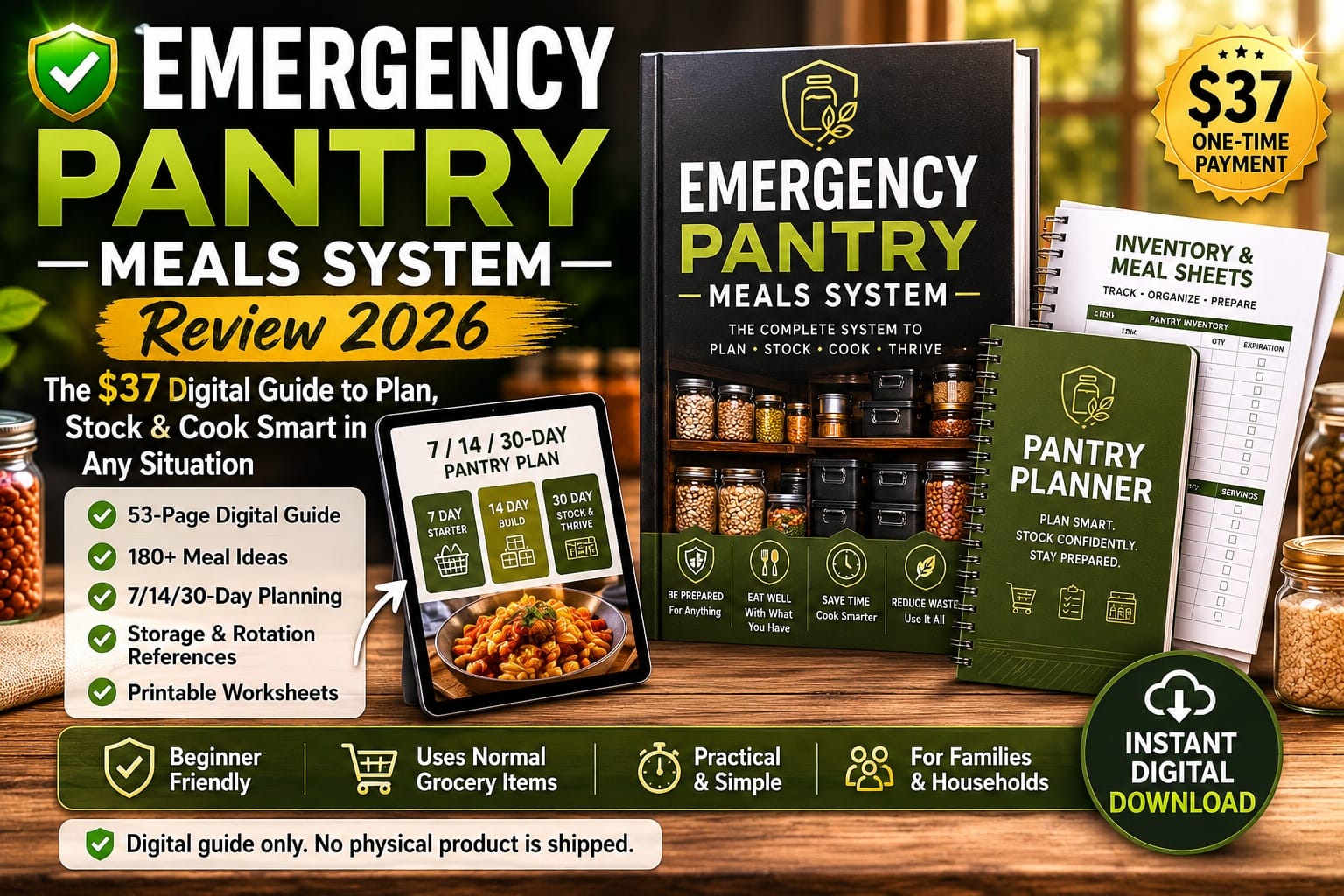
As more households compare practical preparedness tools in 2026, this Emergency Pantry Meals System review explores how the digital guide is positioned to support grocery-store pantry planning, 7/14/30-day meal organization, and buyer research before ordering.
CHICAGO, IL / ACCESS Newswire / June 13, 2026 / Disclaimers: This article is promotional content that contains affiliate links. A commission may be earned on qualifying purchases at no additional cost to the reader. This content is not independent journalism, consumer advocacy, government guidance, emergency-management advice, or professional preparedness planning. Disclosure is provided in accordance with FTC 16 CFR Part 255.
Emergency Pantry Meals System Research: What's Included in 2026?
TL;DR: Emergency Pantry Meals System is a 53-page digital guide sold for $37 through ClickBank. It's built for households that want a structured planning framework for shelf-stable meals using normal grocery-store items - not a physical food supply. The brand states the system includes 180-plus meal ideas, 7/14/30-day planning frameworks, storage and rotation references, and printable planning worksheets. No food ships. What you're buying, per the brand, is an organizational structure for building a practical household pantry without freeze-dried kits or specialty retailers. If you want a planning system rather than a pre-assembled kit, that's what this is positioned as.
Emergency Pantry Meals System 2026 Fast Facts: What Every Buyer Should Know in 30 Seconds
Product: Emergency Pantry Meals System - digital guide
Format: Digital download; PDF access delivered after ClickBank checkout
Brand-listed price: $37 one-time (as observed on official website during review, June 2026 - verify at checkout before purchasing)
Brand reference value: $97 - this is the brand's stated comparison point, not independently verified as a prevailing market price by this publication
Page count: 53 pages (brand-stated)
Meal ideas included: 180-plus (brand-stated)
Planning frameworks: 7-day, 14-day, and 30-day pantry build layers
What's included: Main guide, meal library, planning system, reference charts, quick-use pages
Physical product shipped: No - digital delivery only
Retailer: ClickBank (Click Sales Inc., 1444 S. Entertainment Ave., Suite 410, Boise, ID 83709)
Refund policy: Governed by ClickBank's current published policies - verify eligibility and timeframes at checkout or through your order confirmation
Customer support: [email protected]
Official website: Click Here
Category: Digital preparedness education - not a food supply, medical advice, or emergency management service
License grant: Personal household use only per brand Terms; no resale or redistribution permitted
Prior wire coverage: No prior Accesswire/Newswire coverage was identified in the sources reviewed during preparation of this article - this should not be interpreted as a complete historical audit of all media coverage
As of: June 2026
Buyer Takeaway 1: Emergency Pantry Meals System is a digital planning guide, not a food delivery service. If you're looking for freeze-dried meal kits or pre-assembled emergency food buckets, this isn't the product. If you want a structured planning framework to build your own pantry from normal grocery-store items - on your budget, at your own pace - that's what the brand positions this as.
What Is the Emergency Pantry Meals System?
Emergency Pantry Meals System is a 53-page digital guide positioned for households that want a practical organizational framework for building a shelf-stable emergency pantry. According to the brand, it includes 180-plus meal ideas, 7/14/30-day planning layers, shelf-life and rotation references, and printable planning pages - all built around normal grocery-store foods. It's sold as a one-time $37 digital purchase through ClickBank. No physical product is shipped.
Access the Emergency Pantry Meals System through the official product page
Disclosure: If you buy through this link, a commission may be earned at no extra cost to you.
What Does the Emergency Pantry Meals System Cost?
The brand-listed price is $37 as a one-time digital purchase through ClickBank's checkout, as observed on the official website during the preparation of this article in June 2026. The brand lists a $97 reference value on the product page - this is the brand's stated comparison point and has not been independently verified by this publication as a prevailing market price for comparable guides. No subscription or auto-renewal component is described in the brand's public materials. Always verify the current price at ClickBank's checkout before completing your transaction, as pricing can change without notice per the brand's Terms.
Does the Emergency Pantry Meals System Work for Beginners?
In the context of a digital planning guide, "work" refers to whether the framework may help households organize their pantry planning activities - not to physical food storage outcomes or emergency preparedness guarantees. This publication hasn't independently tested the guide's content. The brand positions Emergency Pantry Meals System explicitly for beginners and practical families, structuring it around layered 7/14/30-day frameworks so households starting from zero can build gradually rather than buying everything at once. Whether that framework meets your specific household's needs is something only the guide's actual content can answer.
Is the Emergency Pantry Meals System a Physical Product?
No. Emergency Pantry Meals System is a digital product only. After purchase through ClickBank's checkout, buyers receive electronic access to downloadable PDF files - no physical book, kit, food supply, or printed materials are shipped. The brand states explicitly on its product page: "Instant digital access. One-time payment. No physical product will be shipped." Confirm your device can open PDF files before purchasing.
Why Households Are Looking at Pantry Planning Guides in 2026
Something's shifted in how ordinary families think about emergency food. It's not the doomsday prepper crowd driving this anymore - it's the parent who remembers when the grocery shelves were genuinely empty, the renter who got stuck for five days after a regional storm, the busy household that realized they couldn't actually cook a single meal from what was in their pantry if the power went out tonight.
The desire to fix that is real. The part that stops people isn't the desire - it's the overwhelm. Where do you even start? What do you buy first? How much is enough? How do you keep things from expiring before you use them? And honestly, what can you actually eat from a shelf-stable pantry that doesn't taste like punishment?
That's the gap Emergency Pantry Meals System says it fills. Not the extreme-survival curriculum. Not a $300 bucket of freeze-dried food that you'll forget is in the garage. According to the brand's official materials, it's a practical, layered planning system built around foods you already recognize and buy at your normal grocery store.
The positioning is deliberately anti-doomsday. The brand's own language says it plainly: this is "not about fear, extreme survival claims, or complicated stockpiling." That framing matters for a specific kind of buyer - the one who got overwhelmed looking at freeze-dried kit prices and thought, "there has to be a simpler way to do this."
Buyer Takeaway 2: The category context is worth understanding before you buy anything here. The emergency food SERP is dominated by physical kit brands - freeze-dried meals, calorie-dense ration buckets, 25-year shelf-life products at $75 to several hundred dollars. Emergency Pantry Meals System is in a completely different lane: a planning guide that helps you build from your grocery store rather than from a specialty retailer. These aren't competing options - they solve different problems.
What's Actually Inside the Emergency Pantry Meals System
According to the official product page at https://emergencypantrymeals.com/, Emergency Pantry Meals System includes five components. Here's what the brand says about each one.
The Main Guide - the 53-page core document. The brand describes it as the framework for understanding how to build a pantry by category rather than just buying random items, and how to make a system that stays organized and functional over time rather than becoming a pile of forgotten cans.
The Meal Library - 180-plus meal ideas organized across six categories: no-cook, low-cook, one-pot, family meals, comfort foods, and snack options. The practical point here is answering "what can I actually make from this?" - which is the question most households can't answer when they're standing in front of their existing pantry during an outage or disruption.
The Planning System - 7-day, 14-day, and 30-day frameworks. The brand structures these as layers you build in sequence rather than one massive all-or-nothing purchase. You start at 7 days, get comfortable, then extend to 14, then to a month. That's a significantly less overwhelming path than trying to build a 30-day supply in one shopping trip.
Reference Charts - shelf-life, storage, and rotation references. The rotation piece is where most self-built pantries quietly fail over time: people buy things, put them in a cabinet, and forget about them until they're two years expired. A structured rotation system is what separates a functional pantry from an expensive feeling of preparedness that doesn't actually work when you need it.
Quick Pages - planning worksheets and quick-use reference pages. The brand describes these as printable household planning tools.
The guide also includes a water planning overview and power outage food planning notes, per the product page - two practical additions that address the "but what if the power's actually out?" question that the meal library itself opens up.
Buyer Takeaway 3: Five components are documented on the product page. The brand doesn't publish a detailed chapter-by-chapter outline in its public materials. If you want to know the specific structure before purchasing, the direct path is [email protected].
Does the Emergency Pantry Meals System Work?
In the context of a digital planning guide, "work" refers to whether the framework may help households organize their pantry planning activities - not to physical food storage outcomes, emergency response effectiveness, or preparedness guarantees. This publication has not independently tested the guide's content.
With that framing clear: what does the publicly available information suggest about whether this kind of framework provides practical value?
There's no independent third-party testing or review of this specific guide as of June 2026. What's assessable from public materials is the structural approach - and that approach is sound. Building in layers instead of all at once, organizing by meal category rather than by random product type, incorporating rotation and shelf-life tracking - these are exactly the principles that distinguish a functional emergency pantry from the "pile of stuff I bought once and forgot" version.
FEMA's ready.gov, the American Red Cross, and the University of Minnesota Extension's household preparedness resources all point toward the same practical framework: start with a short-duration supply, build systematically, plan meals rather than just stockpiling ingredients, and rotate regularly. The brand's structural approach is consistent with that body of guidance. Whether the specific implementation of it in this guide's 53 pages is thorough, well-organized, and genuinely useful is something you can only determine by reading the content itself.
What the guide explicitly doesn't claim, per the brand's own Terms: it doesn't guarantee preparedness for any specific emergency, doesn't replace professional emergency management guidance, and doesn't substitute for following official safety instructions from local authorities.
Buyer Takeaway 4: There's a meaningful difference between "will this guide give you useful structure" and "does owning this guide mean you're prepared for an emergency." The honest answer to the first is probably yes, if you actually use it. The honest answer to the second is that no guide can make that promise - and the brand doesn't try to.
Emergency Pantry Meals System 2026 Quick Verification Snapshot
Brand-listed price: $37 one-time (as observed on official website during review, June 2026)
Brand reference value: $97 - brand-stated comparison point; not independently verified as a prevailing market price
Page count: 53 pages (brand-stated)
Meal ideas count: 180-plus (brand-stated)
Physical product: None - digital only
Checkout processor: ClickBank - your transaction is governed by ClickBank's current terms and refund policies
Refund terms: Governed by ClickBank's current published policies - verify eligibility and applicable timeframes at checkout before purchasing
Operator name/address: Not publicly disclosed on product page - ClickBank's address serves as the retailer-of-record disclosure
Third-party reviews: No third-party reviews or consumer feedback were identified in the sources reviewed during preparation of this article as of June 2026
Official website: https://emergencypantrymeals.com/
Customer support: [email protected]
As of: June 2026
Emergency Pantry Meals System Pricing: What You're Actually Paying
The brand-listed price is $37. The product page references a $97 "regular value." Here's what you need to know about that comparison before completing your purchase.
The $97 figure is the brand's stated reference value and has not been independently verified by this publication as a prevailing market price for comparable digital preparedness planning guides. The FTC's guidance on reference pricing requires that comparison prices reflect actual prior or prevailing prices - the brand is responsible for that compliance, and buyers should treat the $97 figure as a brand-stated comparison point rather than an independently confirmed benchmark.
The $37 price is for digital access only. Nothing physical ships. Digital delivery happens through ClickBank's checkout system after payment.
On shipping and taxes: because this is a digital product, shipping doesn't apply. Any tax component would be calculated at ClickBank's checkout. Verify your final total before completing the transaction.
On refunds: per the brand's Terms, refund handling is governed by ClickBank's current published policies. Your order confirmation email and ClickBank's support process are the documented channels for refund requests. Don't assume specific terms - verify them at checkout before purchasing.
Buyer Takeaway 5: The real pricing question isn't $37 versus $97. It's whether a $37 planning guide provides more value to your household than spending that same $37 directly on grocery-store pantry staples or working through free resources from FEMA and the Red Cross. That's a judgment call only you can make based on how much time and organizational effort you want to invest on your own.
View current pricing and access the Emergency Pantry Meals System
Who This Guide Is Built For - and Who It Probably Isn't For
The brand is pretty direct about its target audience in its public materials. It's for three types of households:
Families who want to plan shelf-stable meals - including snacks and comfort foods, not just survival rations - for disruptions that affect normal household routines. The positioning is everyday practical, not extreme.
Beginners who are starting from scratch and feel overwhelmed. The layered 7/14/30-day frameworks are specifically built to reduce that paralysis. You don't need to buy a month's worth of food in one trip. You build from a week and go from there.
Busy households who want ready-made frameworks and reference pages - not a deep curriculum they have to develop themselves. The planning worksheets are positioned as time-savers for households that want a system without having to build one from scratch.
Where this guide probably isn't the right fit:
If you need food in your house right now, a planning guide doesn't substitute for purchasing physical food supply. It helps you plan what to buy - it doesn't buy it for you.
If you're an experienced prepper who already runs a well-organized rotation system with detailed shelf-life tracking and 90-plus days of supply built out, a 53-page introductory framework probably covers ground you've already worked through.
If you need official guidance tailored to your specific geography, local hazards, or household health circumstances, free resources from FEMA's ready.gov, the American Red Cross, and your local emergency management office are purpose-built for that kind of location-specific and situation-specific guidance.
Buyer Takeaway 6: The brand targets practical families and beginners - not survivalists, not experienced preppers. If you're already operating an organized pantry with a working rotation system, be honest with yourself about the marginal value before purchasing.
What the 180-Plus Meal Ideas Actually Cover
The brand organizes the meal library across six categories: no-cook, low-cook, one-pot, family meals, comfort foods, and snack options. That range matters more than it might sound.
The no-cook category is arguably the most practically important. When a power outage hits, your stove might not work, your microwave definitely won't, and the last thing you want to discover is that your entire emergency pantry requires cooking. Having a solid base of genuinely no-cook options changes the calculus of a power outage from stressful to manageable.
Comfort foods and snacks matter for a different reason: morale. It's easy to dismiss this as non-essential, but households that have only stocked bare-minimum survival calories find that children, in particular, don't eat things they don't recognize under stress. Having familiar comfort options in the mix is practical, not indulgent.
One point worth being direct about: the brand doesn't publish a detailed category breakdown of those 180-plus ideas in its public materials. Whether the library skews toward any particular category, and whether the meal ideas are a good match for your household's tastes and dietary needs, isn't something that can be evaluated from outside the guide. If that matters to you before purchasing, contact [email protected] and ask directly.
The grocery-store-based approach the brand uses is worth understanding. Everything in the guide is built around foods available at any normal grocery store - not specialty freeze-dried ingredients, not survivalist retailers, not anything that requires a separate Amazon order. That's a deliberate design choice. It means the food is familiar, it integrates naturally into your existing shopping rotation, and it's lower-cost per unit than purpose-built emergency products. The trade-off is shorter shelf lives than freeze-dried alternatives and more ongoing management to keep things fresh.
Buyer Takeaway 7: Household-specific factors - dietary restrictions, allergies, how many people you're feeding, and your cooking capacity during a power outage - will heavily shape how many of those 180-plus ideas are actually usable for you. The brand doesn't publish dietary-specific breakdowns. If that's a significant variable for your household, verify it before purchasing.
The Layered Planning Framework: 7-Day, 14-Day, 30-Day
The layered framework is, honestly, one of the smarter structural choices in a digital preparedness guide. Here's why it matters practically.
Most households that try to build an emergency pantry from scratch stall out somewhere between "great idea" and "where do I put 30 days of food." The 30-day target feels enormous when you're starting from nothing. The budget question alone is enough to make people give up before they've bought a single can.
Building in layers solves that. A 7-day pantry buffer is achievable in a few grocery trips. It doesn't require a separate storage system. It doesn't blow a budget. And it actually changes your household's risk profile in a meaningful way - a week of shelf-stable supply covers the vast majority of short-term disruptions that ordinary families actually face: a storm, a sick week where shopping doesn't happen, a regional supply blip.
From 7 days, extending to 14 is a natural next step rather than a leap. And 14 days is the threshold that preparedness organizations like FEMA and the Red Cross have long cited as a meaningful buffer for regional disasters.
The 30-day layer is the goal state - but it's not the starting point. That framing is what makes the brand's positioning work for beginners rather than intimidating them out of starting.
Buyer Takeaway 8: The layered approach is a sound structural decision for a guide targeting households starting from zero. Whether the specific recommendations in each layer match your household's size, storage space, and budget depends on the guide's actual content - something that's not fully assessable from the product page alone.
Is the Emergency Pantry Meals System Legitimate?
For the purposes of this review, "legitimate" refers to product availability, checkout infrastructure, and publicly available business disclosures - not product effectiveness or preparedness outcomes.
On those terms: yes, it checks out. The product is distributed through ClickBank, one of the most established digital product checkout platforms - they've been processing digital product transactions since 1999 and handle millions of purchases annually. The checkout infrastructure, payment security, and refund-request process are ClickBank's responsibility, and that's a meaningful protection layer for buyers.
The brand has published Privacy Policy, Terms and Conditions, and Contact pages - all dated May 26, 2026. That's recent setup, which is expected for a first release. There are no third-party reviews, consumer feedback, or complaints identified in the sources reviewed during preparation of this article as of June 2026. That absence is neutral - it's what you'd expect from a brand-new product with no prior wire coverage.
What the product page doesn't disclose: the operating business entity's name or address. The ClickBank retailer notice supplies ClickBank's address as the retailer of record, which is standard for digital products sold through that platform. But if you want to verify the brand operator's identity or business registration independently, that information isn't available from the product page as it currently stands.
Buyer Takeaway 9: ClickBank's infrastructure provides baseline transaction protections. No evidence of fraudulent activity, misleading practices, or consumer complaints appears in the sources reviewed. The absence of an operator name/address on the product page is common for ClickBank-distributed digital products - it's worth noting, but it's not a red flag in isolation.
How Emergency Pantry Meals System Fits Into the Broader Preparedness Category
It's worth being direct about the category distinction here, because it prevents a buyer mismatch.
The emergency food market in 2026 is dominated by physical product brands - Mountain House, Augason Farms, 4Patriots, ReadyWise, and similar companies that sell pre-packaged, long-shelf-life food kits. These products serve buyers who want food already stored and ready, with shelf lives measured in years or decades, requiring minimal ongoing management. You buy the bucket, you put it in the closet, you forget about it for five years.
Emergency Pantry Meals System is something different: a planning guide that helps you build your own pantry using grocery-store staples. You still have to buy the food. You have to organize it. You have to rotate it. The guide provides the structure for doing that well rather than buying random things and hoping for the best.
These aren't competing options. A household could genuinely benefit from both: the planning guide to organize grocery-based pantry staples, and a physical emergency kit as a separate longer-shelf-life layer. Or they might choose to go fully grocery-based and skip the purpose-built emergency food products entirely. The brand's positioning is specifically grocery-store-based - that's the lane it's in.
The cost difference is real: $37 for a planning guide versus $75 to several hundred dollars for a physical emergency food kit. Those are genuinely different investments with different ongoing commitments and different practical roles in a household's preparedness approach.
Buyer Takeaway 10: If your priority is having physical food on hand right now, a planning guide doesn't solve that problem. If your priority is building a system for using normal grocery-store food more effectively as a preparedness buffer, that's what this is positioned to help with.
What the Brand's Own Terms Actually Say
Any honest review of a preparedness product should surface what the brand itself says about what the product is and isn't. These are the key points from the Emergency Pantry Meals System Terms and Conditions, Privacy Policy, and product page - all publicly available documents.
On product purpose: the brand is explicit that this guide is for "general educational and informational purposes only." It's not emergency management advice, not medical advice, not food safety advice, and not a guarantee of preparedness for any specific event or situation. The brand states this multiple times across multiple documents - it's a clear, deliberate limitation.
On outcomes: "We make no guarantees regarding your results, preparedness level, food storage outcomes, emergency readiness, safety, health, savings, or any other specific outcome." That's a comprehensive limitation that covers essentially every dimension of what "this works" might mean for a preparedness product.
On household variation: the Terms explicitly acknowledge that individual results depend on household size, location, budget, storage space, local laws, food availability, dietary needs, medical considerations, climate, emergency type, and other factors outside the brand's control. Your results from this guide will depend on your household's specifics - and the brand is honest about not being able to account for all of those.
On refunds: the Terms direct buyers to ClickBank's policies. The brand's support email ([email protected]) is available for assistance locating your order, but the actual refund process runs through ClickBank.
On affiliates: the Terms are clear that affiliates are independent third parties responsible for their own claims and compliance. Affiliates may not make guaranteed preparedness claims, safety promises, or outcome guarantees about the products. That's a meaningful prohibition that the brand has written into its affiliate terms.
Buyer Takeaway 11: The brand's own Terms are notably clear about what this guide isn't. It's an educational tool, not a preparedness guarantee. That's honest framing for what a digital planning guide can and can't do - and it's what a buyer should expect.
What General Preparedness Guidance Says About This Approach
FEMA's ready.gov, the American Red Cross, and university extension programs like those at the University of Minnesota all publish free household preparedness guidance. Their frameworks are directionally consistent with the layered planning approach the Emergency Pantry Meals System brand describes - none of them endorse any commercial product, and this article isn't suggesting they do.
Their shared framework: start with a 72-hour supply, build systematically toward 14 days and beyond, plan meals rather than just accumulating ingredients, track shelf life, and rotate regularly. That's the same structural logic the brand's guide is built around.
Some practical context from that general guidance that applies here:
Shelf-life management is more consequential than most buyers anticipate. Canned goods typically carry usable shelf lives of one to three years under standard storage conditions, though actual durations vary by product type, packaging, storage temperature, and manufacturer guidance - always follow product labeling and official food safety recommendations. Dry goods like rice, lentils, and pasta, stored in properly sealed containers, can last substantially longer under appropriate conditions. The difference between "I have an emergency pantry" and "I have food that's still good in an emergency" is consistent rotation.
Cooking capacity is a real variable. "No-cook" options aren't a nice-to-have - they're often essential when power is out and heating food isn't straightforward. Having a significant portion of your pantry in genuinely no-prep options changes the practical utility of your supply during an actual outage.
Household-specific planning isn't optional. Family size, dietary restrictions, storage space, water access, and budget constraints all determine what a functional pantry looks like specifically for your household. A general framework can provide structure - but it can't substitute for the household-specific decision-making that good preparedness requires.
Preparedness Authority Note: Preparedness recommendations vary significantly depending on your location, climate, household size, medical requirements, and local emergency-management conditions. Readers should consult ready.gov, the American Red Cross at redcross.org, and their local emergency management agency for location-specific and situation-specific guidance. These organizations do not endorse Emergency Pantry Meals System, and this article does not suggest any affiliation between the brand and any government or nonprofit organization.
Buyer Takeaway 12: The planning approach described in the brand's materials is consistent with what established preparedness organizations recommend. The guide's value is in having that structure packaged and organized rather than having to assemble it from multiple free sources yourself. Whether that's worth $37 to your household depends on your time, your organizational needs, and how likely you are to actually use a structured guide versus free resources.
What You Don't Get With the Emergency Pantry Meals System
Knowing what a product doesn't include is often as practically important as knowing what it does. Here's the direct accounting based on public materials.
You don't get food. The guide tells you what to buy and how to organize it - it doesn't buy or supply any of it.
You don't get personalized guidance. The guide is a general framework built for a broad audience. It can't account for your specific dietary restrictions, medical requirements, local emergency risk profile, or available storage configuration. If those factors are significant for your household, the guide's general frameworks will only take you so far.
You don't get ongoing coaching, community access, or live support. No such component is described in the public materials. Support is through [email protected].
You don't get a timeline promise. The brand doesn't say "complete your pantry in X days." You work through the frameworks at your own pace, on your own budget.
You don't get a detailed pre-purchase preview of the guide's content. The product page describes the five components and their scope - it doesn't publish a detailed table of contents or chapter outline before you buy.
Buyer Takeaway 13: For $37, what you're buying is organized, packaged guidance that would otherwise require assembling from scratch using free resources. The honest question is whether that packaging is worth $37 to your specific household - and that depends on factors only you can weigh.
How to Purchase the Emergency Pantry Meals System
The purchase process is straightforward. Visit the official product page at https://emergencypantrymeals.com/ and select "Order Now." This routes you to ClickBank's checkout. After completing payment through ClickBank's secure system, you receive digital access to the guide. The brand describes this as instant, though you should allow for standard processing time.
If you don't receive access, check your inbox, spam folder, and promotions folder first. If the access information still doesn't appear, contact [email protected] with your name, the email address used at checkout, your order number if available, and a description of the issue.
For refund or billing questions, your order confirmation email and ClickBank's support channels are the documented paths.
One practical note: always confirm that the price shown at ClickBank's checkout matches the promotional materials you've seen. Pricing can change without notice per the brand's Terms.
Buyer Takeaway 14: The purchase path runs through ClickBank's established checkout infrastructure. Your order confirmation email is your reference for everything post-purchase - keep it.
Confirm current availability and access details for Emergency Pantry Meals System
Emergency Pantry Meals System Frequently Asked Questions
Is the Emergency Pantry Meals System a physical product?
No. It's a digital product only. After purchase through ClickBank, you receive electronic access to downloadable PDF files - no physical book, food supply, kit, or printed materials are shipped. The brand states it plainly on the product page: "Instant digital access. One-time payment. No physical product will be shipped." Make sure your devices can open PDF files before purchasing.
What does the Emergency Pantry Meals System cost?
The brand-listed price is $37 as of June 2026 - a one-time payment with no subscription component described in the brand's public materials. The brand references a $97 "regular value" figure, which is the brand's stated comparison point and hasn't been independently verified by this publication as a prevailing market price. Verify the current price at checkout before completing your purchase, as pricing can change without notice per the brand's Terms.
What is the refund policy for Emergency Pantry Meals System?
Refund handling is governed by ClickBank's current published policies per the brand's Terms. Your order confirmation email is the starting point - it contains your order details and available support options. You can also contact [email protected] with your order number, the email used at checkout, and your refund request details. Verify refund eligibility and applicable timeframes at checkout or through ClickBank's support channels before assuming specific terms apply, since policies can change.
What are the 7-day, 14-day, and 30-day frameworks in the Emergency Pantry Meals System?
According to the brand, these are layered planning frameworks that let households build their pantry gradually - 7 days first as the baseline buffer, then extending to 14 days (which aligns with common preparedness organization recommendations for regional disruptions), then to the 30-day fuller build. The brand positions these as sequential steps, not a single leap. You don't have to reach 30 days before the guide is useful. The specific contents of each framework layer aren't detailed in the public product materials.
Does Emergency Pantry Meals System work for people with dietary restrictions?
The guide is a general planning framework built around normal grocery-store foods. The brand doesn't publish a dietary-restriction-specific breakdown of the 180-plus meal ideas in public materials. The brand's Terms explicitly list dietary needs as one of the household-specific factors that affect individual outcomes. Buyers with significant restrictions - allergies, medical dietary requirements, specialty diets - should contact [email protected] to ask how the guide addresses their situation before purchasing.
How is Emergency Pantry Meals System different from free FEMA or Red Cross resources?
FEMA's ready.gov and the American Red Cross publish free household preparedness guidance covering the conceptual framework and baseline checklists. Emergency Pantry Meals System is positioned - by the brand - as a more structured and comprehensive planning package: specific meal ideas, layered planning frameworks, rotation guidance, and printable reference pages in a single cohesive guide. The practical difference is packaging and specificity. Whether that's worth $37 versus self-assembling from free resources is a buyer-judgment call that depends on your time, your organizational preferences, and how likely you are to actually follow through with self-directed planning.
Is Emergency Pantry Meals System for experienced preppers?
Based on the brand's own positioning: no. The product page targets practical families, beginners, and busy households - not experienced preppers or survivalists. It says explicitly: "This is not about fear, extreme survival claims, or complicated stockpiling." If you already run a well-organized pantry with a systematic rotation schedule and comprehensive meal planning, this guide is likely covering ground you've already worked through. The brand's most useful audience, per its own framing, is households starting from scratch or those who have accumulated some pantry items but lack an organized system.
What is ClickBank and why is it the retailer for Emergency Pantry Meals System?
ClickBank - formally Click Sales Inc. (1444 S. Entertainment Ave., Suite 410, Boise, ID 83709) - is one of the most established digital product checkout platforms, in operation since 1999. They serve as the retailer of record for Emergency Pantry Meals System, which means your transaction, payment processing, and refund requests are governed by ClickBank's policies. This is a standard arrangement for digital product brands distributing through the ClickBank marketplace. The ClickBank infrastructure provides established payment security, refund-request processing, and buyer protection mechanisms.
Does the Emergency Pantry Meals System guarantee preparedness for an emergency?
No. The brand's Terms state explicitly: "We make no guarantees regarding your results, preparedness level, food storage outcomes, emergency readiness, safety, health, savings, or any other specific outcome." The guide is a general educational and informational product. Actual preparedness outcomes depend on household-specific factors including size, location, budget, storage capacity, dietary needs, and local risk profile. For emergency-specific guidance tailored to your location, FEMA's ready.gov and your local emergency management office are the authoritative sources.
Can I share or resell the Emergency Pantry Meals System guide?
No. Per the brand's Terms, purchasers receive a "limited, personal, non-exclusive, non-transferable license to use the materials for your own personal household use." You may print copies for personal use. The Terms explicitly prohibit reselling, redistributing, sharing, uploading, publishing, reproducing, or commercially exploiting the materials without written permission. This is standard digital product licensing.
What's included in the Emergency Pantry Meals System's 5-in-1 description?
Per the official product page: (1) the Main Guide - 53 pages of core pantry framework; (2) the Meal Library - 180-plus meal ideas across no-cook, low-cook, one-pot, family, comfort food, and snack categories; (3) the Planning System - 7-day, 14-day, and 30-day pantry build layers; (4) Reference Charts - shelf-life, storage, and rotation references; and (5) Quick Pages - planning worksheets and quick-use reference pages. Everything is delivered digitally after ClickBank checkout.
What should I do if I can't access my Emergency Pantry Meals System download?
Check your email inbox, spam folder, and promotions folder first - your access details typically arrive immediately after checkout. If you still can't locate them, contact [email protected] with your full name, the email address used at checkout, your order number if available, and a description of the issue. ClickBank's customer support process (accessible through your order confirmation) can also assist with access and billing questions.
Does the Emergency Pantry Meals System cover water storage?
According to the product page, yes - the guide includes a "water planning overview." Specific details about that section's depth aren't published in the public materials beyond that mention. For water storage guidance with specific quantity recommendations and purification options, FEMA's ready.gov and local emergency management organizations publish detailed guidance you can reference independently.
Is Emergency Pantry Meals System backed by professional certifications or expert credentials?
The product page doesn't publish author credentials, professional certifications, expert endorsements, or institutional affiliations in its publicly available materials. The guide is positioned as a practical household planning resource rather than a credentialed emergency management program. If the level of professional credentialing matters to your purchasing decision, that's worth verifying by contacting [email protected] before purchasing.
How long does it take to build an emergency pantry using this guide?
The brand doesn't specify a timeline. The layered 7/14/30-day framework is self-paced by design. Your actual build timeline will depend on budget, how often you shop, your current pantry starting point, and how much storage space you're working with. The guide's approach explicitly avoids rapid-transformation expectations - gradual building over multiple shopping trips, not a single bulk purchase.
What's the difference between Emergency Pantry Meals System and freeze-dried emergency food kits?
Emergency Pantry Meals System is a digital planning guide - it helps you organize what to buy from your grocery store. It includes no food. Freeze-dried emergency food kits are physical products - pre-packaged, purpose-built meals with multi-year or multi-decade shelf lives, delivered to your door. These are different product categories. Freeze-dried kits prioritize convenience and extreme shelf life at a higher price point. A grocery-store pantry system prioritizes familiar food, lower cost, and integration with everyday shopping at the trade-off of shorter shelf lives and more ongoing management. Many households use both as complementary layers.
Does the guide address power outage meal planning specifically?
Yes, per the product page - it includes "power outage food planning notes" and a no-cook meal category within the 180-plus meal library. Those no-cook options are particularly relevant for power outage scenarios where your cooking infrastructure may be unavailable. Specific details of the power outage section aren't published in public materials beyond these mentions.
Is this guide appropriate for apartment dwellers with limited storage?
The brand doesn't specifically address storage-constrained households in its public materials. Storage space is explicitly listed in the brand's own Terms as one of the household-specific factors affecting individual outcomes. Whether the guide's frameworks include advice calibrated for limited storage is worth confirming with [email protected] if that's a significant constraint for your situation.
Buyer Takeaway 15: The FAQ section above covers the most common pre-purchase questions based on the brand's publicly available materials. For anything not addressed here, the brand's support email is [email protected]. For refund and order questions, your ClickBank order confirmation is the starting point.
Verification Checklist: What to Confirm Before You Buy
If you're seriously considering this guide, here are the practical things worth verifying before completing a purchase:
1. Current price at ClickBank's checkout. The $37 brand-listed price is confirmed as of June 2026. Verify the price you see at checkout before completing your transaction.
2. Refund terms. The brand's Terms defer to ClickBank's current policies. Confirm the current refund terms directly at checkout - don't assume specific terms apply without verifying.
3. Dietary compatibility. If your household has significant dietary restrictions or allergies, contact [email protected] before purchasing to understand how the guide addresses those.
4. PDF access on your devices. The guide delivers as downloadable PDF files. Confirm your devices support PDF access before purchasing.
5. Whether a planning guide solves your actual problem. If you need physical food supply now, a planning guide doesn't solve that. If you have food but no system for organizing, rotating, or actually cooking it during a disruption, that's the problem this guide is positioned to help with.
Buyer Takeaway 16: A planning guide is a specific tool for a specific problem - knowing what problem you're trying to solve before buying any solution saves money and frustration.
Where to Access the Emergency Pantry Meals System
The guide is available through the affiliate link in this article, which routes to the official product page. All purchases process through ClickBank's checkout.
Buyers who prefer to verify the product page independently can go directly to https://emergencypantrymeals.com/. Whether you arrive through an affiliate-tracked link or by typing the URL directly, the price you pay is the same - the affiliate commission, if any is earned, is paid by the brand, not added to your purchase total.
Buyer Takeaway 17: The affiliate commission referenced in the opening disclosure is paid by the brand. It doesn't affect your purchase price. Keep your ClickBank order confirmation email - it's your reference for product access, billing questions, and refund requests.
Confirm current availability and access details for Emergency Pantry Meals System
What This Review Covers and What It Can't Tell You
This review is based entirely on publicly available materials: the official Emergency Pantry Meals System product page, the brand's Terms and Conditions, Privacy Policy, and Contact pages, and category-level context from general preparedness resources. This publication hasn't received a copy of the guide, hasn't tested the guide's content, and hasn't interviewed anyone from the brand.
That means there are real things this review can't tell you: whether the meal ideas are well-suited to your household's tastes, whether the planning frameworks are thorough enough for your needs, whether the writing is clear and actionable, or whether the reference charts are genuinely useful when you're actually trying to build a pantry. Those answers only come from working through the guide itself.
What this review can tell you: the price, the structure, the scope of what's included, the Terms that govern your purchase, and the gaps in what's publicly verifiable. That's the honest accounting of what an affiliate-based review can responsibly deliver.
Buyer Takeaway 18: This review is accurate and complete based on publicly available sources. It's one input - not the only one. If you need to know whether the content itself is worth $37 to your specific household, the most reliable path is either contacting the brand with specific questions or working through the guide under whatever refund terms apply at the time of your purchase.
Final Assessment: Emergency Pantry Meals System 2026
Here's what the public record actually supports - no inflation, no watering down.
Emergency Pantry Meals System is a real digital product distributed through ClickBank's established checkout infrastructure. It costs $37 for a 53-page PDF guide that includes a meal planning library, layered planning frameworks, and reference materials for building and maintaining a household pantry using normal grocery-store foods. The brand positions it as an educational planning tool for practical families and beginners - not a guaranteed preparedness solution and not a substitute for official emergency management guidance.
The grocery-store-based lane it occupies is genuinely differentiated from the physical emergency food kit market that dominates this category. This guide is for building a pantry, not buying one. That distinction is both its most significant value and its most significant limitation depending on what you actually need.
The brand's own Terms are thorough and honest in limiting what the guide promises. There are no outcome guarantees. There are no preparedness claims. What's offered is structure - and structure applied consistently to normal grocery-store buying habits is exactly the difference between a household that has useful food in a disruption and one that has a pile of expired cans in the back of a cabinet.
For households starting from scratch, feeling overwhelmed, and wanting an organized path rather than a pile of random purchases: the $37 ask for a structured 53-page planning system with 180-plus meal ideas and layered frameworks is coherent with what's being sold. For households that want physical food supply now, or who prefer to build from FEMA and Red Cross free resources on their own time: the case is less clear-cut.
That's the honest assessment. No superlatives, no pressure, no manufactured urgency. Just what the public record shows about what you're buying.
Buyer Takeaway 19: The clearest fit for this guide is a household that wants a structured planning system for building a grocery-store-based emergency pantry, finds the $37 price reasonable, and prefers organized guidance over self-assembled research. If you're that household, the positioning fits your problem. If you need food on hand now or want a system built around long-shelf-life specialty products, this isn't the right product for that need.
Frequently Asked Questions - Extended
What happens if I change my mind after buying?
Per the brand's Terms, refunds are handled by ClickBank according to ClickBank's current policies. Your order confirmation email is the starting point for any refund request. You can also contact [email protected] with your order number, the email used at checkout, and your refund request details. Verify current refund terms at checkout or through ClickBank's support channels before purchasing, as policies can change without notice.
Is this guide useful if I already have some food stored?
Yes, potentially - the brand positions the guide for households across a range of starting points, including those who have some pantry basics but lack an organized system. If your situation is "I have canned goods and dry staples but no real rotation plan or meal framework," the guide's structure is directly relevant to where you are. If you're already running a well-organized system with active rotation, you're likely past what the guide covers.
Does the guide include household-size planning guidance?
The product page describes "household-size planning guidance" as part of the guide's scope. Specific detail about how household size affects each planning layer isn't published in the public product materials. Buyers with large or multi-generational households who want to confirm the guide addresses their scale should contact [email protected] before purchasing.
Can I print the materials?
Yes, per the brand's Terms - purchasers may print copies for personal household use. Printed copies may not be resold, redistributed, or used commercially. The personal-use license is standard for digital guide products.
What devices can I use to access the guide?
The guide is delivered as a digital PDF after ClickBank checkout. Any device capable of opening PDF files - computers, tablets, smartphones - should be able to access the materials. The brand's Terms note that you're responsible for ensuring your device, software, and PDF reader are compatible with the digital product format. If you're unsure about compatibility, verify PDF access on your devices before purchasing.
Check current pricing and get started with Emergency Pantry Meals System today
Contact Information
Company: Emergency Pantry Meals System
Email: [email protected]
Toll Free: 1-800-390-6035
International:+1 208-345-4245
Disclaimers
Advertorial Disclosure: This article is promotional content that contains affiliate links. A commission may be earned on qualifying purchases at no additional cost to the reader. This content is not independent journalism, consumer advocacy, government guidance, emergency-management advice, or professional preparedness planning. Disclosure is provided in accordance with FTC 16 CFR Part 255. This content is promotional in nature and is intended for consumer education regarding a commercially available product. Customer ratings and testimonials are brand-reported, not independently audited by this publication. Individual experiences vary.
ClickBank Retailer Notice: CLICKBANK® is a registered trademark of Click Sales Inc., a Delaware corporation located at 1444 S. Entertainment Ave., Suite 410, Boise, ID 83709, USA and used by permission. ClickBank's role as retailer does not constitute an endorsement, approval, or review of these products or any claim, statement, or opinion used in the promotion of these products.
Material Limitations of This Review: This review is based exclusively on publicly available materials, including the official Emergency Pantry Meals System website at https://emergencypantrymeals.com/, the brand's published Terms and Conditions, Privacy Policy, and Contact pages, and category-level educational context from general household preparedness resources. This publication has not received a complimentary copy of the guide, has not tested the guide's content, has not interviewed brand personnel, and has not been granted access to internal product specifications beyond what is publicly published. Claims described in this article as "according to the brand," "brand-stated," or "per the official Terms" reflect what the brand has publicly stated and have not been independently substantiated by this publication. Buyers are encouraged to verify any claim that materially affects their purchase decision by contacting [email protected] directly.
Third-Party Consumer Feedback Platforms: This article references the existence of third-party consumer feedback platforms in general category terms only. This publication does not endorse, vouch for, audit, or accept responsibility for the accuracy, completeness, or fairness of customer reviews posted on any third-party platform, including but not limited to general-purpose review sites, social media platforms, and online discussion forums. Buyers consulting third-party reviews are encouraged to evaluate them critically, look for verified-purchase indicators where available, and weigh reviewer-specific context against their own situation.
Forward-Looking Statements and Article Accuracy: This article reflects information available as of June 2026 and was prepared using reasonable care to be accurate and useful at the time of publication. Product specifications, pricing, promotional offers, digital delivery details, refund policies, contact information, and customer feedback data may change after publication without notice. Statements describing expected buyer outcomes, performance expectations, or category trends are educational forward-looking observations, not guarantees. No representation is made that the information will remain accurate in the future. Readers should rely on the official Emergency Pantry Meals System website at https://emergencypantrymeals.com/ as the authoritative source for current product information prior to any purchase decision.
Reasonable Consumer Standard: This article is written for a general adult consumer audience and intends statements to be interpreted as a reasonable consumer would interpret them in context. Where a statement could otherwise be read as a brand-substantiated fact, attribution language such as "according to the brand," "brand-stated," "brand-reported," or "per the official Terms" identifies it as a brand claim that has not been independently verified by this publication. All performance descriptions, product positioning language, and value comparisons originate with the Emergency Pantry Meals System brand's own published materials and are identified in this article as brand-asserted marketing language, not as independent third-party rankings, performance guarantees, or verified claims by this publication. The $97 reference value is a brand-stated comparison point and has not been independently verified by this publication as a prevailing market price for comparable products.
Geographic and Jurisdiction Note: Emergency preparedness requirements, food storage recommendations, and household safety guidance vary by geographic location, local law, and individual household circumstances. This article is written for a general audience. Buyers are responsible for complying with applicable local laws and official guidance from local, state, and national emergency management authorities. EU buyers: "before" prices displayed in brand marketing materials are brand reference points; EU buyer rights under applicable EU consumer protection frameworks are unaffected by this content. Residents of all jurisdictions are encouraged to confirm current product terms directly with the brand prior to purchase.
General Disclaimer: Emergency Pantry Meals System is a digital educational product for general informational purposes only. It is not emergency management advice, medical advice, food safety advice, nutritional advice, or a guarantee of preparedness for any specific event or situation. Individual outcomes vary. Always follow local laws, official safety guidance, food safety recommendations, and instructions from qualified authorities. For urgent emergency, safety, medical, or crisis situations, contact the appropriate local authorities, emergency services, or qualified professionals immediately.
SOURCE: Emergency Pantry Meals System