




Monday, 18 May 2026 09:40 AM
Company Update
Battery Cell Dry Room Dehumidification Systems Industry Accelerates as Gigafactory Expansion, Lithium-Ion Production Scaling, and Ultra-Low Humidity Control Drive Next-Generation EV Battery Manufacturing
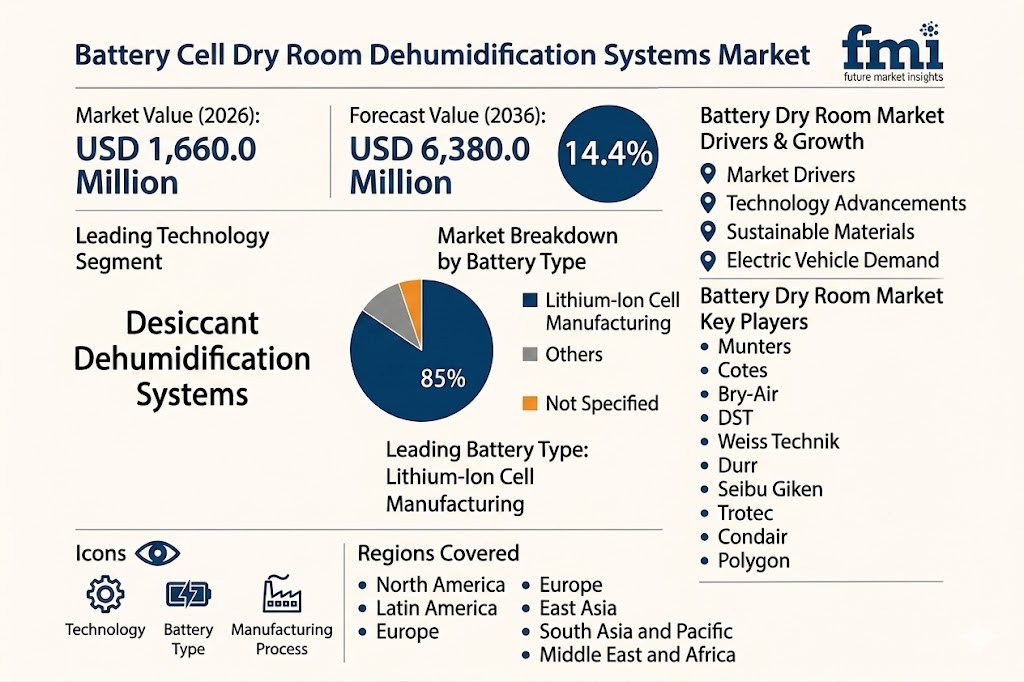
NEWARK, DE / ACCESS Newswire / May 18, 2026 / According to the latest industry analysis by Future Market Insights (FMI), the rapid industrialization of electric vehicle (EV) battery production is reshaping the global manufacturing ecosystem, placing unprecedented focus on ultra-dry production environments. The global Battery Cell Dry Room Dehumidification Systems Market, valued at USD 1,660.0 million in 2026, is projected to reach USD 6,380.0 million by 2036, expanding at a robust CAGR of 14.4% during the forecast period.
The market's acceleration is being driven by the growing complexity of lithium-ion battery manufacturing, where even minimal moisture exposure can compromise cell chemistry, reduce performance, and increase safety risks. As gigafactory investments surge worldwide, battery manufacturers are prioritizing advanced dry room dehumidification systems capable of delivering highly controlled humidity levels with audit-ready operational data.
Get detailed market forecasts, competitive benchmarking, and pricing trends:
https://www.futuremarketinsights.com/reports/sample/rep-gb-33069
Key Market Metrics (2026-2036)
Metric | Value |
|---|---|
Market Value (2026) | USD 1,660.0 Million |
Forecast Value (2036) | USD 6,380.0 Million |
CAGR (2026-2036) | 14.4% |
Incremental Opportunity | USD 4,720.0 Million |
Leading Technology Segment | Desiccant Dehumidification Systems |
Technology Segment Share | 48.0% |
Leading Battery Type | Lithium-Ion Cell Manufacturing |
Battery Segment Share | 71.0% |
Leading Solution Type | Turnkey Dry Room Systems |
Solution Segment Share | 45.0% |
Fastest Growing Country | India (17.3% CAGR) |
Moisture Control Becomes a Strategic Manufacturing Priority
Battery cell production requires extremely low humidity conditions to protect sensitive materials such as lithium salts and electrolytes. Manufacturers are increasingly moving beyond conventional HVAC systems toward dedicated dry room technologies engineered specifically for high-volume battery environments.
"Dry room infrastructure is no longer viewed as a supporting utility-it has become a core production asset," notes an FMI analyst. "Battery manufacturers now demand measurable humidity control, process traceability, uptime reliability, and scalable deployment models that align with next-generation gigafactory operations."
The market is witnessing a strong transition from pilot-scale implementation toward full-scale operational programs, particularly among manufacturers expanding EV battery capacity across North America, Europe, and Asia-Pacific.
Desiccant Systems Dominate as Precision Drying Demand Intensifies
Among technology segments, desiccant dehumidification systems are projected to account for 48.0% market share in 2026, emerging as the dominant solution due to their ability to maintain ultra-low dew points consistently across large-scale production environments.
These systems are gaining traction because they offer:
Stable humidity control below 1% relative humidity
Reduced contamination risks in lithium-ion cell assembly
Improved production consistency and product quality
Better energy optimization for large-scale facilities
Scalable integration with automated manufacturing workflows
At the same time, ultra-dry air handling units and heat-recovery dehumidifiers are witnessing increased adoption among manufacturers seeking energy-efficient and sustainable factory operations.
Lithium-Ion Cell Manufacturing Remains the Core Growth Engine
Lithium-ion battery production is expected to represent 71.0% share of the market in 2026, supported by expanding EV production targets, stationary energy storage deployment, and government-backed battery localization initiatives.
Dry room systems have become indispensable across critical battery production stages, including:
Electrode manufacturing
Cell assembly
Electrolyte filling
Aging and formation processes
Quality testing and packaging
Manufacturers are increasingly investing in turnkey dry room systems, which are forecast to hold 45.0% market share in 2026. These integrated solutions reduce implementation complexity while offering centralized monitoring, automation, and long-term operational support.
Access the Complete Report in PDF Format: https://www.futuremarketinsights.com/reports/brochure/rep-gb-33069
Regional Outlook: India Emerges as the Fastest-Growing Market
While demand remains global, regional expansion patterns vary considerably depending on battery manufacturing investments and localization policies.
United States (15.2% CAGR)
The United States continues to strengthen its position as a major demand center, supported by federal clean energy incentives, domestic battery production expansion, and growing investments in EV supply chain resilience. Manufacturers are prioritizing scalable dry room infrastructure capable of supporting large gigafactory ecosystems.
India (17.3% CAGR)
India is projected to emerge as the fastest-growing market through 2036, fueled by aggressive EV adoption targets, government-linked battery manufacturing incentives, and expanding domestic cell production capacity. Demand is particularly strong for modular and turnkey dry room systems that enable rapid deployment.
China (13.8% CAGR)
China remains one of the world's largest battery manufacturing hubs, with continued investments in lithium-ion capacity expansion driving sustained demand for advanced humidity control systems. Local manufacturers are increasingly emphasizing operational efficiency and production scalability.
South Korea & Germany
South Korea (14.5% CAGR) and Germany (14.1% CAGR) are expected to remain critical innovation centers for premium battery manufacturing, where process reliability and production precision remain essential competitive differentiators.
Technology Integration and Service-Led Deployment Shape Market Competition
The competitive landscape is evolving rapidly as buyers prioritize integration quality, implementation support, and measurable operational outcomes over standalone equipment sales.
Leading manufacturers including:
Munters
Cotes
Bry-Air
DST
Weiss Technik
Durr
Seibu Giken
Trotec
Condair
Polygon
are increasingly focusing on:
AI-enabled environmental monitoring
Predictive maintenance capabilities
Energy-efficient drying technologies
Integrated process control systems
Remote diagnostics and service support
Multi-site deployment scalability
Competition is steadily shifting toward service-led implementation models, where vendors provide long-term operational support, workflow integration, compliance documentation, and continuous system optimization.
Market Challenges: Integration Complexity and Energy Efficiency Concerns
Despite strong momentum, the market faces several operational challenges. Integration complexity remains a major barrier, particularly among manufacturers operating legacy systems that require seamless compatibility with new dry room technologies.
In addition, energy consumption associated with maintaining ultra-low humidity environments continues to place pressure on operational costs. Vendors are therefore investing heavily in heat recovery systems, intelligent controls, and energy optimization technologies to reduce long-term power consumption.
Manufacturers are also demanding stronger data traceability, audit-ready reporting, and automation capabilities as battery production standards become increasingly stringent worldwide.
Buy Report: Unlock 360° insights for strategic decision making and investment planning:
https://www.futuremarketinsights.com/checkout/33069
The Outlook: From Specialized Infrastructure to Gigafactory Standard
As EV battery manufacturing scales globally, dry room dehumidification systems are expected to transition from specialized engineering solutions into standardized production infrastructure across gigafactories.
By 2036, the market's future will be defined not only by humidity control performance, but also by integration depth, measurable efficiency gains, energy optimization, and the ability to support increasingly automated battery manufacturing ecosystems.
The next decade will likely see dry room systems evolve into intelligent operational platforms-combining environmental control, predictive analytics, and manufacturing intelligence to support the global transition toward electrified mobility and large-scale energy storage.
Related Reports:
EV Battery Module and Cell Disassembly Automation Systems Industry Size in EU- https://www.futuremarketinsights.com/reports/demand-analysis-of-ev-battery-module-and-cell-disassembly-automation-systems-in-europe
Paper Drying Systems Market- https://www.futuremarketinsights.com/reports/paper-drying-systems-market
Electric Boiler Market- https://www.futuremarketinsights.com/reports/electric-boiler-market
About Future Market Insights (FMI)
Future Market Insights (FMI) is a leading provider of market intelligence and consulting services, serving clients in over 150 countries. Headquartered in Delaware, USA, with a global delivery center in India and offices in the UK and UAE, FMI delivers actionable insights to businesses across industries including automotive, technology, consumer products, manufacturing, energy, and chemicals.
An ESOMAR-certified research organization, FMI provides custom and syndicated market reports and consulting services, supporting both Fortune 1,000 companies and SMEs. Its team of 300+ experienced analysts ensures credible, data-driven insights to help clients navigate global markets and identify growth opportunities.
For Press & Corporate Inquiries
Rahul Singh
AVP - Marketing and Growth Strategy
Future Market Insights, Inc.
+91 8600020075
For Sales - [email protected]
For Media - [email protected]
For web - https://www.futuremarketinsights.com/
For Web - https://www.factmr.com/
SOURCE: Future Market Insights, Inc.