




Friday, 15 May 2026 05:15 PM
Company Update
Growing demand for intelligent lighting automation, BMS-integrated daylight controls, and retrofit-friendly wireless commissioning systems is driving adoption across warehouses, factories, commercial buildings, and public infrastructure projects worldwide.
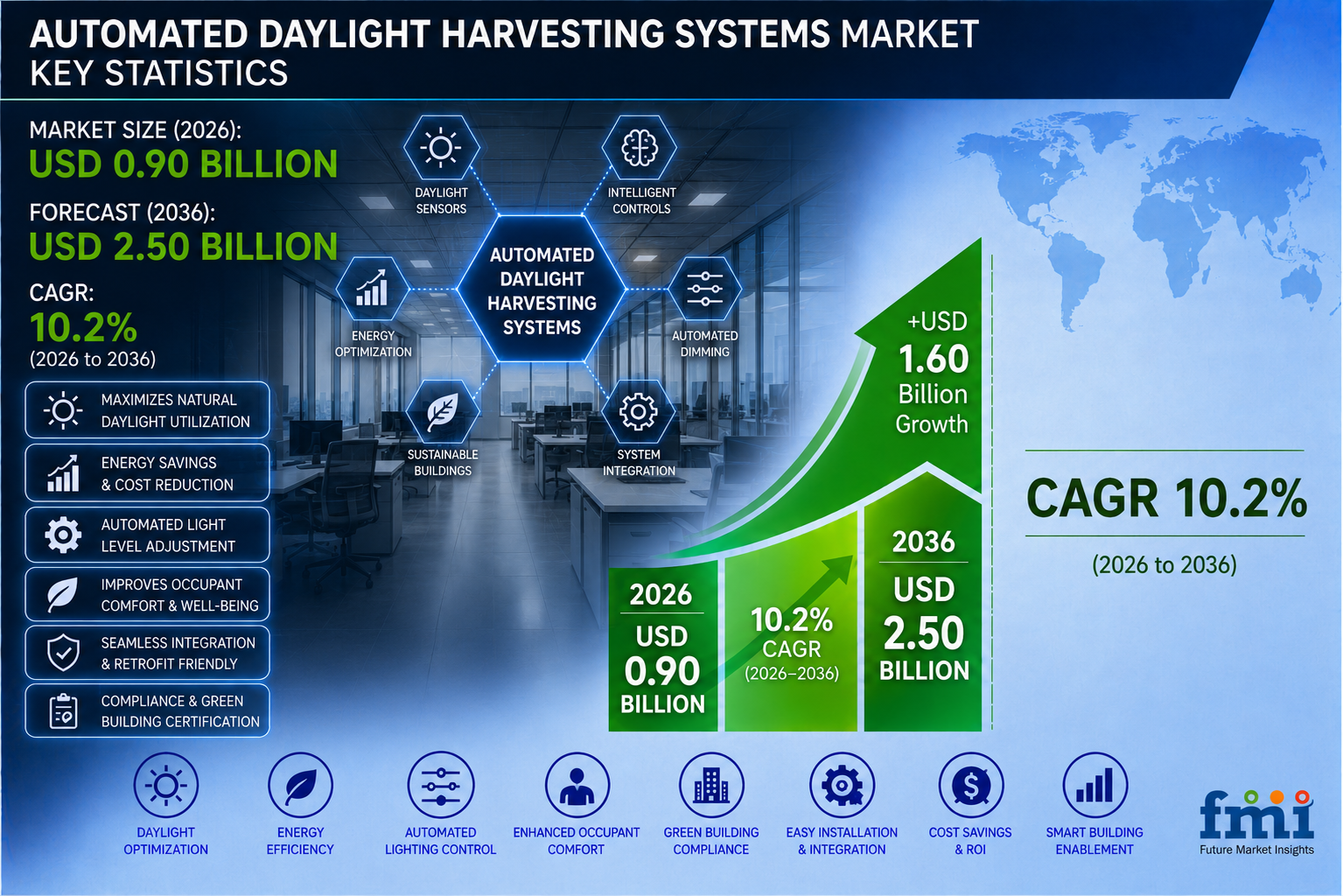
NEWARK, DE / ACCESS Newswire / May 15, 2026 / According to the latest analysis by Future Market Insights, the global automated daylight harvesting systems market is entering a strong growth phase as commercial and industrial building owners increasingly invest in intelligent lighting controls designed to reduce electricity consumption, improve building energy performance, and support smart infrastructure modernization. The market was valued at USD 0.82 billion in 2025 and is projected to reach USD 0.90 billion in 2026. Over the forecast period from 2026 to 2036, the market is expected to expand significantly to USD 2.50 billion, registering a CAGR of 10.2%.
This growth reflects the increasing demand for automated lighting systems capable of adjusting electric light output based on available natural daylight, occupancy patterns, and centralized building energy management requirements. As industrial facilities, warehouses, offices, and public infrastructure environments continue prioritizing energy efficiency and operational sustainability, automated daylight harvesting systems are emerging as strategic building technologies supporting lower power consumption, improved occupant comfort, and intelligent facility management.
Quick Stats: Automated Daylight Harvesting Systems Market
Market Value (2025): USD 0.82 billion
Estimated Market Value (2026): USD 0.90 billion
Forecast Market Value (2036): USD 2.50 billion
CAGR (2026 to 2036): 10.2%
Incremental Opportunity: USD 1.60 billion
Leading System Type Segment: Networked Daylight Control (38.0% share in 2026)
Leading Project Type Segment: Retrofit Projects (57.0% share in 2026)
Leading Integration Segment: BMS-Integrated Setups (43.0% share in 2026)
Fastest Growing Markets: Japan (12.4% CAGR) and United Kingdom (11.8% CAGR)
Key Growth Driver: Rising adoption of intelligent lighting controls for commercial energy optimization and retrofit modernization
Major Players: Signify, Acuity Brands, Schneider Electric, Siemens, Honeywell, Johnson Controls, ABB, Legrand, Zumtobel Group, Tridonic
Get detailed market forecasts, competitive benchmarking, and pricing trends:
https://www.futuremarketinsights.com/reports/sample/rep-gb-33063
Market Value Analysis: Intelligent Lighting Controls Reshape Building Energy Management
Between 2026 and 2030, adoption of automated daylight harvesting systems is expected to accelerate as commercial building operators, industrial facilities, and public infrastructure managers increasingly prioritize connected energy-saving technologies capable of reducing unnecessary lighting consumption.
Building owners and facility managers are increasingly focusing on:
Networked daylight-responsive lighting controls
Automated dimming systems linked with natural daylight availability
Wireless lighting commissioning for retrofit projects
Building management system (BMS)-integrated lighting controls
Smart warehouse and industrial lighting automation
Occupancy-linked daylight harvesting platforms
Centralized lighting analytics and energy dashboards
HVAC-lighting integrated building control systems
Failure to optimize lighting performance against daylight availability may expose facilities to higher electricity costs, weaker sustainability performance metrics, rising operational expenses, and reduced building energy efficiency.
From 2030 to 2036, growth will be supported by increasing smart building investments, expansion of retrofit modernization projects, stronger commercial energy regulations, and wider integration of connected lighting infrastructure within intelligent building ecosystems.
Technology Evolution: Networked Controls and Building Integration Drive Innovation
The evolution of automated daylight harvesting systems is being shaped by advancements in photosensor technology, wireless commissioning, cloud-connected lighting platforms, and building automation integration.
Key innovations include:
Networked daylight control systems
Wireless daylight-responsive lighting platforms
Advanced photosensor dimming technologies
BMS-linked lighting optimization systems
Occupancy and daylight integrated controls
Cloud-connected lighting analytics dashboards
Facade-linked and skylight-integrated control systems
Intelligent energy management software for lighting automation
A major challenge remains balancing sensor accuracy, occupant comfort, retrofit complexity, commissioning quality, and centralized building integration across diverse commercial environments.
An industry analyst notes:
"Automated daylight harvesting systems are evolving from standalone lighting controls into intelligent building optimization platforms. Facility operators increasingly want connected systems capable of reducing electricity use, improving operational visibility, and integrating seamlessly with broader smart building infrastructure."
Daylight Harvesting Becomes Central to Smart Building Energy Optimization
As commercial and industrial buildings continue modernizing energy infrastructure, automated daylight harvesting systems are becoming increasingly important across warehouses, offices, factories, educational institutions, and public facilities.
Core capabilities include:
Automated electric light dimming based on daylight availability
Reduced building electricity consumption
Improved building sustainability performance
Centralized facility lighting management
Enhanced occupant comfort and visual consistency
Better integration with HVAC and energy management systems
Wireless retrofit commissioning support
Multi-zone lighting optimization across large facilities
This transition is positioning automated daylight harvesting systems as strategic building technologies across industrial parks, logistics facilities, commercial offices, warehouses, educational campuses, and smart infrastructure projects.
Speak to Analyst: Customize insights for your business strategy:
https://www.futuremarketinsights.com/customization-available/rep-gb-33063
Segment Spotlight
Networked Daylight Control Leads System Type Segment (38.0%)
Driven by increasing demand for centralized lighting management, remote configuration capability, and multi-zone energy optimization across large commercial facilities.
Warehouses Lead Building Type Segment (34.0%)
Supported by high lighting usage, extensive skylight exposure, and growing demand for energy-efficient logistics infrastructure.
BMS-Integrated Setups Expand Across Smart Building Projects (43.0%)
Reflecting rising demand for connected energy management systems linking lighting, HVAC, occupancy, and facility analytics into centralized building operations.
Retrofit Projects Lead Project Type Segment (57.0%)
Driven by growing preference for energy-saving lighting upgrades that reduce operational costs without requiring complete lighting infrastructure replacement.
Regional Insights: Smart Buildings and Energy Regulations Fuel Global Growth
The automated daylight harvesting systems market is expanding globally, supported by stricter energy efficiency standards, rising smart building investments, and increasing retrofit modernization activity.
Country | CAGR (2026-2036) | Key Growth Drivers |
|---|---|---|
Japan | 12.4% | Smart factories and precision building controls |
United Kingdom | 11.8% | Non-domestic retrofit modernization and energy compliance |
France | 11.1% | Tertiary building energy reduction mandates |
Germany | 10.5% | Industrial energy optimization and building automation |
India | 9.6% | Industrial infrastructure growth and efficient lighting adoption |
China | 9.3% | Factory-scale lighting automation and industrial parks |
United States | 8.8% | Mature retrofit market and connected lighting modernization |
Regional growth reflects differences in building energy regulations, retrofit readiness, industrial expansion, smart infrastructure investment, and commercial lighting modernization priorities.
Opportunities: Connected Building Platforms Unlock Lighting Control Expansion
Key opportunities shaping the market include:
Expansion of networked daylight-responsive lighting systems
Growth in warehouse and industrial retrofit modernization
Integration of daylight harvesting with smart building platforms
Increasing adoption of wireless lighting commissioning solutions
Growth in centralized energy analytics dashboards
Expansion of occupancy-linked intelligent lighting controls
Rising investment in sustainable commercial infrastructure
These opportunities are enabling suppliers to improve building energy efficiency, operational visibility, occupant comfort, and long-term facility sustainability performance.
Competitive Landscape: Integration Capability and Control Intelligence Define Leadership
The market remains competitive, with leadership shaped by lighting control expertise, building automation integration capability, commissioning support quality, and connected platform intelligence.
Leading companies include:
Signify
Acuity Brands
Schneider Electric
Siemens
Honeywell
Johnson Controls
ABB
Legrand
Zumtobel Group
Tridonic
Competitive differentiation is driven by:
Sensor accuracy and daylight optimization capability
Building automation integration depth
Wireless commissioning functionality
Centralized lighting analytics platforms
Retrofit installation efficiency
Cloud-connected control architecture
Occupancy and HVAC integration support
Multi-site building energy management capability
Future Outlook: Intelligent Daylight Harvesting Emerges as Core Smart Building Infrastructure
Looking ahead to 2036, automated daylight harvesting systems will become increasingly important as commercial buildings continue evolving toward connected, energy-efficient, and sustainability-focused operating environments.
Key trends include:
Wider adoption of networked daylight-responsive lighting systems
Expansion of retrofit-focused wireless commissioning platforms
Growth in cloud-connected lighting analytics
Increasing integration with building management systems
Higher demand for warehouse and logistics lighting optimization
Expansion of occupancy-linked intelligent controls
Greater deployment of smart energy management platforms
As commercial infrastructure environments continue prioritizing operational efficiency and energy optimization, automated daylight harvesting systems are expected to emerge as foundational building technologies supporting intelligent lighting control, sustainability performance, and connected facility management.
Key Developments in the Market
Lighting control providers are increasingly expanding development of networked daylight harvesting systems optimized for multi-zone commercial building management.
Building automation companies continue integrating daylight-responsive lighting controls into centralized smart building platforms supporting HVAC, occupancy, and energy analytics.
Commercial building operators are increasing investment in retrofit daylight harvesting systems designed to improve energy efficiency with minimal installation disruption.
Unlock 360° insights for strategic decision making and investment planning:
https://www.futuremarketinsights.com/checkout/33063
Browse More Industry Reports:
Industrial Lighting Lifecycle Services Market - https://www.futuremarketinsights.com/reports/industrial-lighting-lifecycle-services-market
Waste Recycling Services Market - https://www.futuremarketinsights.com/reports/global-waste-recycling-services-market
Wellness Services Market - https://www.futuremarketinsights.com/reports/global-wellness-services-market
Workplace Menstrual Health Benefits Platform Market - https://www.futuremarketinsights.com/reports/workplace-menstrual-health-benefits-platform-market
Resale Authentication Services Market - https://www.futuremarketinsights.com/reports/resale-authentication-services-market
About Future Market Insights (FMI)
Future Market Insights (FMI) is a leading provider of market intelligence and consulting services, serving clients in over 150 countries. Headquartered in Delaware, USA, with a global delivery center in India and offices in the UK and UAE, FMI delivers actionable insights to businesses across industries including automotive, technology, consumer products, manufacturing, energy, and chemicals.
An ESOMAR-certified research organization, FMI provides custom and syndicated market reports and consulting services, supporting both Fortune 1,000 companies and SMEs. Its team of 300+ experienced analysts ensures credible, data-driven insights to help clients navigate global markets and identify growth opportunities.
For Press & Corporate Inquiries
Rahul Singh
AVP - Marketing and Growth Strategy
Future Market Insights, Inc.
+91 8600020075
For Sales - [email protected]
For Media - [email protected]
For Web - https://www.futuremarketinsights.com/
For Web: https://www.factmr.com/
SOURCE: Future Market Insights, Inc.