



Monday, 29 June 2026 06:40 AM
Company Update
Berlin's decision to scrap the troubled F126 warship programme in favour of the proven MEKO A-200 has erased billions in European defence value, sharpening questions about order-book concentration and the discipline required to hold the sector.
SINGAPORE, SG / ACCESS Newswire / June 29, 2026 / A sudden reversal in German naval procurement is the immediate focal point of European defence markets this week. Berlin confirms the cancellation of the F126 frigate programme, and shares in Rheinmetall, the continent's bellwether defence contractor, fall as much as 18% in the latest session, among its steepest in more than three decades. Analysts at Abishai Financial Asia read it less as a verdict on defence demand than as a lesson in how concentrated a single order book can become.
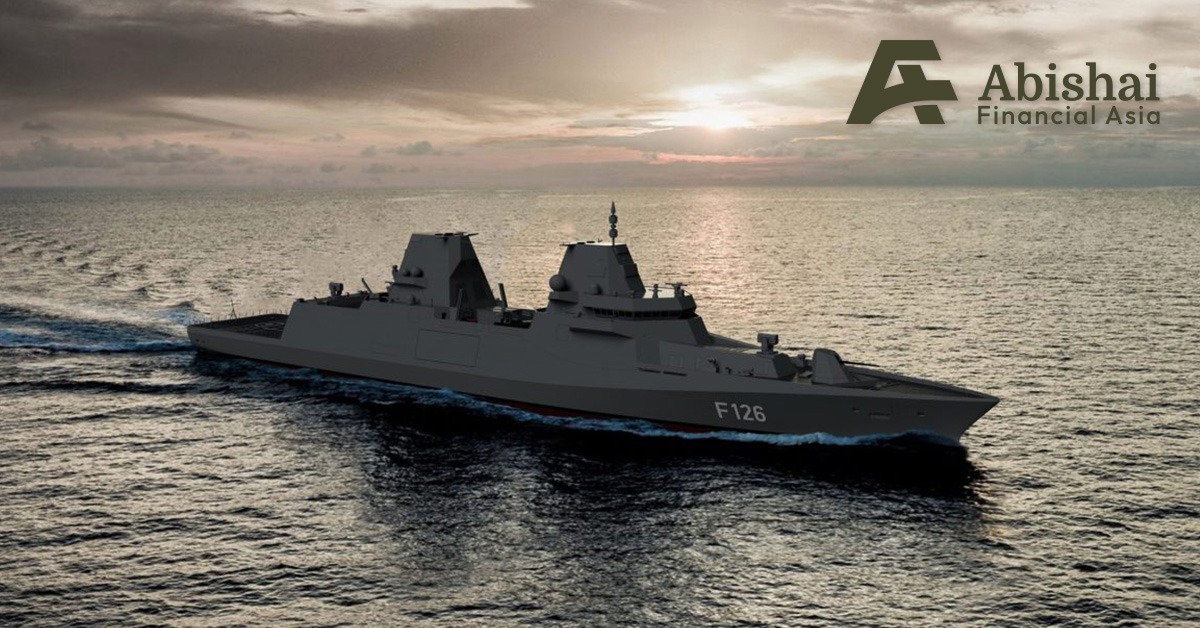
The German defence ministry has formally terminated a warship project whose total costs already exceed $20.5 billion. That sum would have funded the largest naval commission since the Second World War. With Rheinmetall already down 41% over the first half of the year, the decision marks a clear policy shift, placing delivery certainty and cost discipline above specification ambition.
At the centre of the collapse sits Damen Schelde Naval Shipbuilding, holder of the original six-frigate commission worth roughly $11.4 billion. The yard now concedes it can meet neither the construction schedule nor the budget. Talks to pass the work to Naval Vessels Lürssen, which Rheinmetall acquired last year, return a revised estimate of $17.3 billion for the same hulls. The ministry refuses to waive damage claims against Damen, citing the stewardship of public funds, and that refusal closes the final route to a transfer, leaving requirements beyond $20.5 billion, $2.6 billion of it already spent.
Into that vacuum steps ThyssenKrupp Marine Systems, which picks up the replacement contract for eight MEKO A-200 frigates pending budget committee approval. Four vessels are priced at $7.2 billion, with an option on four more, exercisable before the close of the year, at roughly $6 billion. The combined $13.2 billion buys a proven export design already in service with several navies, and the cancellation rewards investors who track "order-book breadth far more reliably than headline revenue growth," a conclusion drawn by Daniel Coventry, Abishai Financial Asia's Director of Private Equity.
The appeal of that design rests on a markedly different risk profile: its specifications are known, its construction parameters settled. First delivery to the German Navy is targeted before the end of the decade, roughly three years ahead of the F126, whose own first delivery has slipped by four years under successive revisions, a slip that sits awkwardly with Germany's commitments to NATO. At close to $1.1 billion a hull, the MEKO also undercuts its predecessor's escalating per-vessel estimates.
For portfolio managers, the sharper questions now concern concentration rather than the underlying health of defence demand. The loss of Rheinmetall's largest prospective warship commission exposes how much weight one programme can carry in an order book. The failed handover also renews scrutiny of the Lürssen acquisition, completed last year on an assumption of transfers that never arrive. Coventry frames the episode as a reminder that valuations built on "anticipated contract transfers carry execution risk that sector tailwinds do not offset."
The sheer scale of the prior advance explains much of the sensitivity now seen across the sector. European defence equities have risen 259% over a three-year procurement boom, with Rheinmetall alone up more than 170% over the previous year before the reversal. Government bond markets move in sympathy: the ten-year Bund yield jumps 30 basis points in a single session, its largest move in a generation, as sector valuation multiples compress. Standard discipline caps single-security exposure at 5% of a portfolio at any one time, one sector at 20% and one geography at 35%, and the sell-off pushes those thresholds back into focus.
The practical response lies in tighter position sizing, in stress testing of management guidance, and in wider diversification across contractors with differently composed order books. Spread that way, no single cancelled programme can dictate overall performance. Stop-loss parameters and scenario simulation let managers define risk budgets more precisely when volatility stays elevated. Coventry treats the forthcoming KNDS listing as a useful "pricing benchmark against which existing holdings can be assessed."
The structural case for the sector still looks intact, and the broad tailwinds behind it show little sign of fading. Germany's $114 billion Bundeswehr commitment runs through the end of the decade, and European Union defence budgets have climbed 11% over the past year and 63% across five years. The sharper question, in the analysis from Abishai Financial Asia, is whether the tilt to proven, cost-efficient platforms marks a durable reorientation or a near-term answer to delivery pressure. That distinction carries real consequences for capital allocation across European defence.
About Abishai Financial Asia Pte. Ltd.
Abishai Financial Asia Pte. Ltd. (UEN:201016239E) is a Singapore-based asset manager established more than fifteen years ago, operating as a research-first partner in capital allocation. Its approach centres on risk-aware compounding in public markets, combining active equity selection, bottom-up research and disciplined rebalancing with overlay tools, among them systematic tilts, opportunistic hedging and drawdown-aware controls. Governance rests on macro-aware risk budgeting, with explicit limits, concentration guardrails, liquidity filters, stress testing and transparent attribution under continuous monitoring. Environmental, social and governance factors are weighed within sector and issuer assessments wherever financially material. The firm continues to explore compliant product wrappers and distribution pathways that could, subject to suitability criteria, widen access to selected solutions for retail-qualified investors. Further information is available at https://abishai.com, and media enquiries may be directed to Peng Joon at [email protected].
SOURCE: Abishai Financial Asia Pte. Ltd.