




Monday, 03 February 2025 07:00 AM
Company Update
The railway traction inverter industry is experiencing steady growth, driven by increasing investments in railway electrification and the global push for energy-efficient and sustainable transportation solutions. As rail networks modernize, particularly with the adoption of high-speed trains and metro systems, the demand for advanced traction inverters has risen. These inverters play a crucial role in optimizing energy use, enhancing performance, and reducing carbon emissions in electric locomotives.
NEWARK, DE / ACCESS Newswire / February 3, 2025 / The railway traction inverter industry is set for consistent growth, driven by the increasing global emphasis on railway electrification and energy efficiency.
The market is expected to expand from USD 4,821.3 million in 2025 to USD 8,313.9 million by 2035, registering a CAGR of 5.6% over the forecast period. Traction inverters are crucial in railway systems, facilitating efficient power conversion and optimizing energy use to propel electric locomotives and railcars.
Government initiatives to modernize railway infrastructure, along with the rising demand for high-speed trains and metro systems, are driving the adoption of traction inverters worldwide.
Additionally, the shift from diesel to electric traction to curb carbon emissions is further propelling market growth. Technological advancements, such as lightweight designs and high-power density solutions, are enhancing the efficiency of contemporary railway systems.
What innovations are enhancing the performance of traction inverters in high-speed trains?
Innovations in traction inverter technology are significantly enhancing the performance of high-speed trains by improving efficiency, reliability, and power density. The adoption of silicon carbide (SiC) and gallium nitride (GaN) semiconductors has led to reduced energy losses, higher switching frequencies, and improved thermal management, enabling lighter and more compact inverter designs. Regenerative braking systems integrated with traction inverters allow trains to recover and reuse energy, increasing overall efficiency.
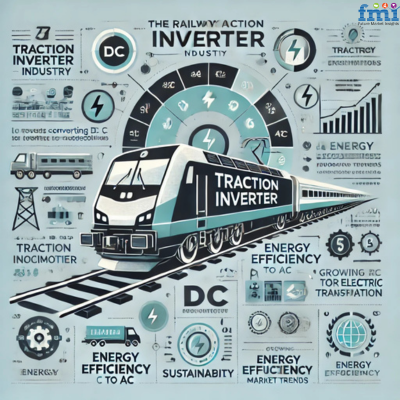
Additionally, advanced cooling technologies, such as liquid and air-cooled systems, help maintain optimal inverter performance under high loads. The incorporation of AI-driven predictive maintenance and real-time monitoring ensures system reliability by detecting potential failures before they occur. Furthermore, the shift towards modular and high-power-density inverters allows for greater adaptability in various rail applications, supporting the growing demand for high-speed rail networks worldwide. These innovations collectively contribute to enhanced energy efficiency, sustainability, and operational performance in modern railway systems.
Get Ahead with Our Report: Request Your Sample Now!
https://www.futuremarketinsights.com/report-sample#5245502d47422d3130353336
What are the key trends in inverter cooling systems for railway applications?
Key trends in inverter cooling systems for railway applications focus on improving thermal management, energy efficiency, and reliability. Liquid cooling systems are gaining popularity due to their superior heat dissipation capabilities, allowing traction inverters to operate efficiently at higher power levels while reducing size and weight. Air-cooled inverters remain a viable option for lower-power applications, benefiting from simplified maintenance and reduced infrastructure requirements. Phase-change materials (PCMs) and advanced heat sinks are also being explored to enhance passive cooling efficiency. Additionally, the integration of intelligent thermal management systems using sensors and AI-driven algorithms enables real-time temperature monitoring and adaptive cooling adjustments, preventing overheating and prolonging equipment lifespan. As railway electrification advances, the demand for more compact, lightweight, and high-performance cooling solutions continues to drive innovation in traction inverter technology.
"The Railway Traction Inverter industry is poised for significant advancements, driven by the growing demand for efficient and sustainable rail solutions. This market is evolving with innovations aimed at improving performance and energy efficiency." - says Nikhil Kaitwade, Associate Vice President at Future Market Insights (FMI).
What are the primary challenges faced by railway traction inverter manufacturers?
Railway traction inverter manufacturers face several challenges, including high development and production costs, as advanced inverter technologies require expensive materials like silicon carbide (SiC) and gallium nitride (GaN) for improved efficiency. Stringent regulatory and safety standards also add complexity, requiring compliance with evolving global railway norms. Thermal management issues remain a critical challenge, as inverters must operate under extreme temperature variations and high-power demands while maintaining reliability. Additionally, supply chain disruptions and semiconductor shortages have impacted production timelines and increased costs. The transition from diesel to electric traction demands significant infrastructure upgrades, creating hurdles in widespread adoption, particularly in emerging markets. Moreover, competition from established and new market players pushes manufacturers to continuously innovate while maintaining cost efficiency. Addressing these challenges requires strategic investments in R&D, supply chain resilience, and advanced cooling and power management technologies.
Key Industry Highlights - Railway Traction Inverter Market
Steady Market Growth - The railway traction inverter market is projected to expand from USD 4,821.3 million in 2025 to USD 8,313.9 million by 2035, growing at a CAGR of 5.6%.
Electrification Driving Demand - Rising investments in railway electrification projects and the transition from diesel to electric traction are key growth drivers.
Technological Advancements - Adoption of silicon carbide (SiC) and gallium nitride (GaN) semiconductors is improving inverter efficiency, power density, and thermal management.
Focus on Energy Efficiency - Innovations like regenerative braking integration and intelligent thermal management systems are enhancing energy recovery and optimizing power usage.
Government Initiatives & Infrastructure Development - Increased funding for high-speed rail projects and metro expansions worldwide is accelerating traction inverter adoption.
Challenges in Supply Chain & Regulations - Semiconductor shortages, raw material costs, and stringent safety regulations continue to pose challenges for manufacturers.
Regional Market Growth - Asia-Pacific, Europe, and North America are leading the market, with China, Japan, and Germany investing heavily in railway modernization.
Sustainability Trends - The push for low-carbon transportation solutions and green energy integration is influencing new traction inverter designs and manufacturing processes.
Detailed Market Study: Full Report and Analysis
https://www.futuremarketinsights.com/reports/railway-traction-inverter-market
Key Sales Trends in the Railway Traction Inverter Market
Rising Demand for Electrified Rail Transport - Increasing global investments in high-speed rail, metro systems, and electric locomotives are driving traction inverter sales.
Growth in Aftermarket Sales - The need for replacement and maintenance of traction inverters in aging railway fleets is contributing to steady aftermarket revenue.
Strong Sales in Asia-Pacific & Europe - China, Japan, Germany, and France are leading the market with large-scale railway electrification projects, boosting inverter adoption.
Preference for Energy-Efficient Solutions - Rail operators are shifting towards high-efficiency traction inverters with regenerative braking capabilities to reduce operational costs and improve sustainability.
Increasing Adoption of SiC & GaN-Based Inverters - Sales of silicon carbide (SiC) and gallium nitride (GaN) traction inverters are rising due to their superior power density, thermal efficiency, and lightweight designs.
Government-Funded Railway Modernization Projects - National infrastructure programs and public-private partnerships (PPPs) are fueling sales of advanced traction inverter systems.
OEM Partnerships & Strategic Collaborations - Leading manufacturers are forming alliances with railway operators and rolling stock manufacturers to secure long-term supply contracts.
Digitalization & Smart Inverter Sales Growth - The integration of AI-driven monitoring, predictive maintenance, and IoT-enabled traction inverters is emerging as a key sales trend.
Regional Industry Overview
Country | CAGR (2025 to 2035) |
India | 7.2% |
Japan | 6.1% |
China | 5.5% |
Germany | 4.9% |
United States | 4.5% |
Trends and Innovations in the Railway Traction Inverter Market
Adoption of Silicon Carbide (SiC) and Gallium Nitride (GaN) Semiconductors
SiC and GaN-based traction inverters offer higher efficiency, reduced energy losses, and improved thermal performance, making them ideal for high-speed and metro rail systems.
These materials enable lighter, more compact designs, reducing overall train weight and increasing energy savings.
Integration of Regenerative Braking
Modern traction inverters now feature energy recovery systems that convert braking energy into usable power, enhancing energy efficiency.
This innovation reduces power consumption and operational costs while supporting sustainable rail transport.
AI-Driven Predictive Maintenance
AI-powered traction inverters use real-time monitoring and predictive analytics to detect potential failures, minimizing downtime and maintenance costs.
These systems help improve reliability and fleet management by enabling proactive maintenance strategies.
Advanced Cooling Technologies
Liquid cooling systems are becoming more prevalent, offering better heat dissipation and efficiency compared to traditional air-cooled solutions.
Phase-change materials (PCMs) and heat sink advancements are being explored to further enhance inverter cooling performance.
Modular and High-Power-Density Designs
Manufacturers are developing compact and modular traction inverters that can be customized based on train power requirements.
These designs improve flexibility and reduce installation and maintenance complexities.
Digitalization & IoT Integration
The use of IoT-connected traction inverters allows railway operators to remotely monitor performance, analyze data, and optimize energy consumption.
Cloud-based platforms are helping rail companies improve efficiency and asset tracking.
Discover Emerging Trends in Electrification Components - Get Your Detailed Analysis Today!
https://www.futuremarketinsights.com/industry-analysis/electrification-components
Regional Analysis of the Railway Traction Inverter Market
Asia-Pacific:
Leading region due to massive investments in railway electrification, particularly in China, Japan, and India.
High demand for high-speed trains and metro systems boosts traction inverter sales.
Europe:
Major players like Germany, France, and the UK driving growth through rail modernization and high-speed rail projects.
Stringent environmental regulations and focus on sustainability foster adoption of energy-efficient traction inverters.
North America:
Increasing interest in high-speed rail systems and electrification of freight railways in the US and Canada.
Government initiatives to improve rail infrastructure push demand for advanced traction inverters.
Middle East & Africa:
Growing investments in metro systems and light rail projects in countries like the UAE and Saudi Arabia.
Strong focus on sustainable mobility and energy-efficient transport systems.
Latin America:
Countries like Brazil and Mexico are modernizing their rail networks, creating opportunities for traction inverter adoption.
Growing demand for energy-efficient systems in urban transportation.
Key Players
Schneider Electric
CRRC
Wabtec
General Electric
Toshiba
Mitsubishi Electric
ABB
Siemens
Alstom
Hitachi
Key Segmentations
By Technology Type:
The segment is further categorized into Silicon Carbide and Si-IGBT.
By Train Type:
The segment is further categorized into Mainline, Metro, High Speed, Freight, and Special.
By Capacity:
The segment is further categorized into Less Than 1 MW and Equal or More than 1 MW.
By Sales Channel:
The segment is further categorized into OEM and Aftermarket.
By Region:
Regions considered in the study include North America, Latin America, Western Europe, Eastern Europe, East Asia, South Asia & Pacific, and the Middle East and Africa.
Have a Look at Related Research Reports of Automotive
The global demand for train battery is estimated to be worth USD 629.1 million in 2024 and is anticipated to reach a value of USD 1,024.7 million by 2034.
The global demand for electric vehicle reducer reached USD 1,974.1 million in 2024 and is further anticipated to witness a year over year growth of 22.3% in the year 2025.
Global vehicle electrification market was reported at USD 66.3 billion in 2020. The demand for vehicle verification is anticipated to reach USD 99.3 billion in 2025.
The global ambulance power inverter market size is anticipated to reach USD 73,229.2 million in 2024. It is estimated to showcase a CAGR of around 5.7% in the forecast period 2024 to 2034.
The global sale of EV charging stations is estimated to be worth USD 26,874.4 million in 2024 and is anticipated to reach a value of USD 143,000.0 million by 2034.
The global vehicle-to-grid (V2G) market is set to reach a value of USD 34702.8 million in 2034 from USD 4486.6 million in 2024.
After a detailed analysis of the electric three wheeler market, FMI recently published a new report on EV charging cable market.
The global electric vehicle motor market is set to strengthen its market hold globally at a promising CAGR of 21% from 2024 to 2034.
The global EV charger converter module market size reached USD 4,054.3 million in 2023 and is expected to total USD 5,019.0 million by 2024.
The global EV Charging Panelboard Market size reached USD 5.2 billion in 2023. Over the forecast period 2024 to 2034, EV charging panelboard demand is anticipated to rise at 17.2% CAGR.
About Future Market Insights (FMI)
Future Market Insights, Inc. (ESOMAR certified, recipient of the Stevie Award, and a member of the Greater New York Chamber of Commerce) offers profound insights into the driving factors that are boosting demand in the market. FMI stands as the leading global provider of market intelligence, advisory services, consulting, and events for the Packaging, Food and Beverage, Consumer Technology, Healthcare, Industrial, and Chemicals markets. With a vast team of 400 analysts worldwide, FMI provides global, regional, and local expertise on diverse domains and industry trends across more than 110 countries.
Join us as we commemorate 10 years of delivering trusted market insights. Reflecting on a decade of achievements, we continue to lead with integrity, innovation, and expertise.
Contact Us:
Future Market Insights Inc.
Christiana Corporate, 200 Continental Drive,
Suite 401, Newark, Delaware - 19713, USA
T: +1-347-918-3531
For Sales Enquiries: [email protected]
Website:https://www.futuremarketinsights.com
LinkedIn| Twitter| Blogs | YouTube
SOURCE: Future Market Insights, Inc.