PR 101
What Is a Press Release
? Definition, Benefits & How-To's
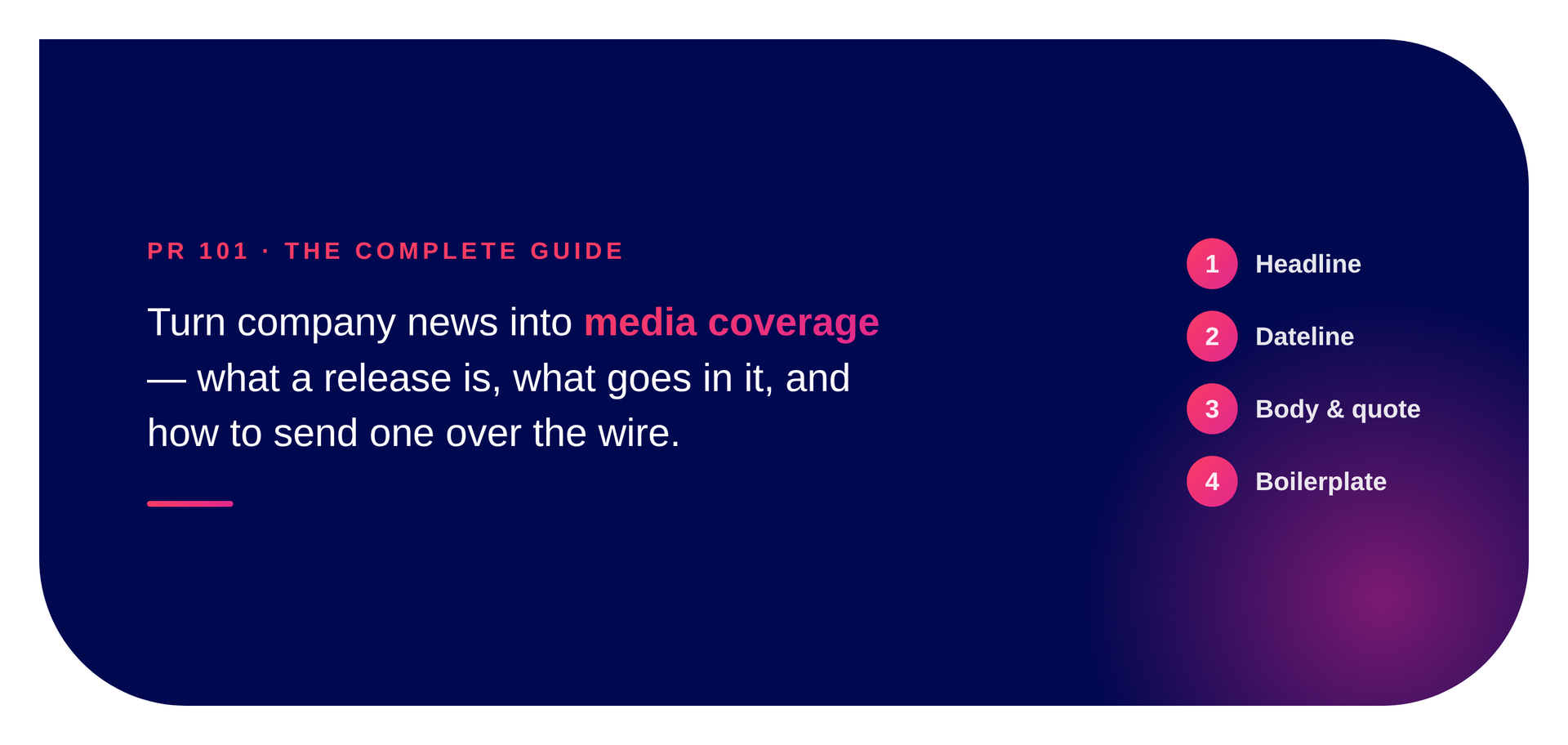
A press release turns company news into media coverage. Here's what a press release is, when to send one, exactly what goes inside it, and how to write and distribute your own over the wire.
Can press release distribution help you reach your target audience? The short answer is yes. But to make the most of your press release distribution
efforts, you need to understand why. In this guide we answer: what a press release is, when and why to use one, what goes in it, and the questions people ask most.
What is a press release
?
A press release is an official announcement an organization sends to share something newsworthy — news about an event, a new hire, the release of industry data, and so on. The goal is to expand the brand's reach and connect with the press and public.
Public relations professionals would much rather their campaigns be about positive news for the brand. That said, a release also plays a pivotal role in crisis communication, helping address and mitigate negative outcomes.
When and why should you use a press release
?
There are plenty of reasons an organization sends a release. Common topics
include but aren't limited to:
- Product launch
- Company milestone
- Quarterly earnings
- New employee
- Events
No matter the topic, your goal is to share something newsworthy with your target audience and the press. Sharing it amplifies your message and expands your reach — and in today's media landscape, the more positive attention you attract, the better.
Standing out as a leader in your industry helps you gain the trust of journalists, and you may become a go-to source for their articles. The relationships you build and nurture with journalists
are a win-win: they fill their article pipeline, and you secure earned media coverage that boosts awareness, generates leads, and fuels growth.
What is in a press release
?
Well-executed campaigns follow a proper press release format
and use the inverted pyramid. Need the full walkthrough? Our guide on how to write a press release
covers the full five-step process. Your release should include:
1
[Company] Announces [The News]
2
New York, NY — January 1, 2026
3
[Company] today announced [the news], giving [audience] a faster way to [benefit].
4
[Supporting detail and a data point.] “[A quote from a named spokesperson],” said [Name], [Title].
5
About [Company]
— [One or two sentences on what the company does.]
6
Media Contact:[Name] · [email] · [phone]
- 1
Attention-grabbing headline
The first thing readers see — it either gets the click or the scroll. Strike a balance between concise and intriguing; our press release headline blog
has tips.
- 2
First paragraph
Place the dateline here and give a brief overview, addressing the who, what, when, where, why, and how.
- 3
Body paragraphs
Support your main message with additional detail. Keep it focused and concise, and include a quote from a C-suite executive or subject-matter expert that adds credibility.
- 4
- 5
Contact information
Every campaign needs media contact details — name, title, phone number, and email.
Press release writing tips
- 1
Stay focused
Focus on one topic per campaign. Address the facts and statistics and share the important details. One topic keeps readers engaged and helps journalists understand your news so they can cover it.
- 2
Follow the proper format
Format matters. You can copy our free press release template
and follow this structure: headline, subheadline, dateline + opening paragraph, body paragraphs + quote, CTA, boilerplate, and contact information.
- 3
Use easily digestible language
Write in plain, active voice and avoid jargon. Simple language improves readers' understanding of your news.
- 4
Include multimedia
Add high-quality images, video, or both. Multimedia enriches your content and gives your news a shareable element.
Press release examples
Now that we've covered the elements and the proper format, it helps to see them come together. A strong example follows the inverted-pyramid structure, leads with a clear, newsworthy headline, and includes a quote and boilerplate.
See annotated press release examples
by announcement type — product launches, partnerships, earnings, and more — or browse current releases on our newsroom
to see the format in action.
Press release FAQs
What is the purpose of a press release?
A press release is a tool organizations use to share news and updates with a specific audience. It gives companies a means to communicate information to the masses.
What is the difference between a news article and a press release?
News articles are typically unbiased and cover the facts of an event — they're meant to inform readers. Press releases require a more strategic touch, since organizations use them to secure positive earned media coverage or to mitigate the collateral damage of a crisis.
Who writes a press release?
Anyone can write one, but they're commonly written by a public relations professional inside an organization or one representing the company.
Are you ready to share your news?
At ACCESS Newswire, what you see is what you get — flat-fee pricing, comprehensive distribution, and around-the-clock support. If you have news to share, we're ready to amplify it.