






Saturday, 21 November 2026 07:15 PM
Company Update
Duane Boise, President and CEO of MMJ International Holdings, Noted: "In Marijuana State Operators Own Sworn Court Filings, the Operators Acknowledge Building Multimillion-Dollar Supply Chains for Years Without Federal DEA Registrations-Now They Are Turning to Federal Judges to Protect the Very System They Built Outside Federal Oversight."
WASHINGTON, D.C. / ACCESS Newswire / November 21, 2026 / MMJ International Holdings, Inc. ("MMJ") today noted a striking turn in the federal marijuana rescheduling litigation: state-licensed marijuana operators who welcomed the April 2026 rescheduling order are now suing the Drug Enforcement Administration in the same federal appeals court where MMJ is challenging that order.
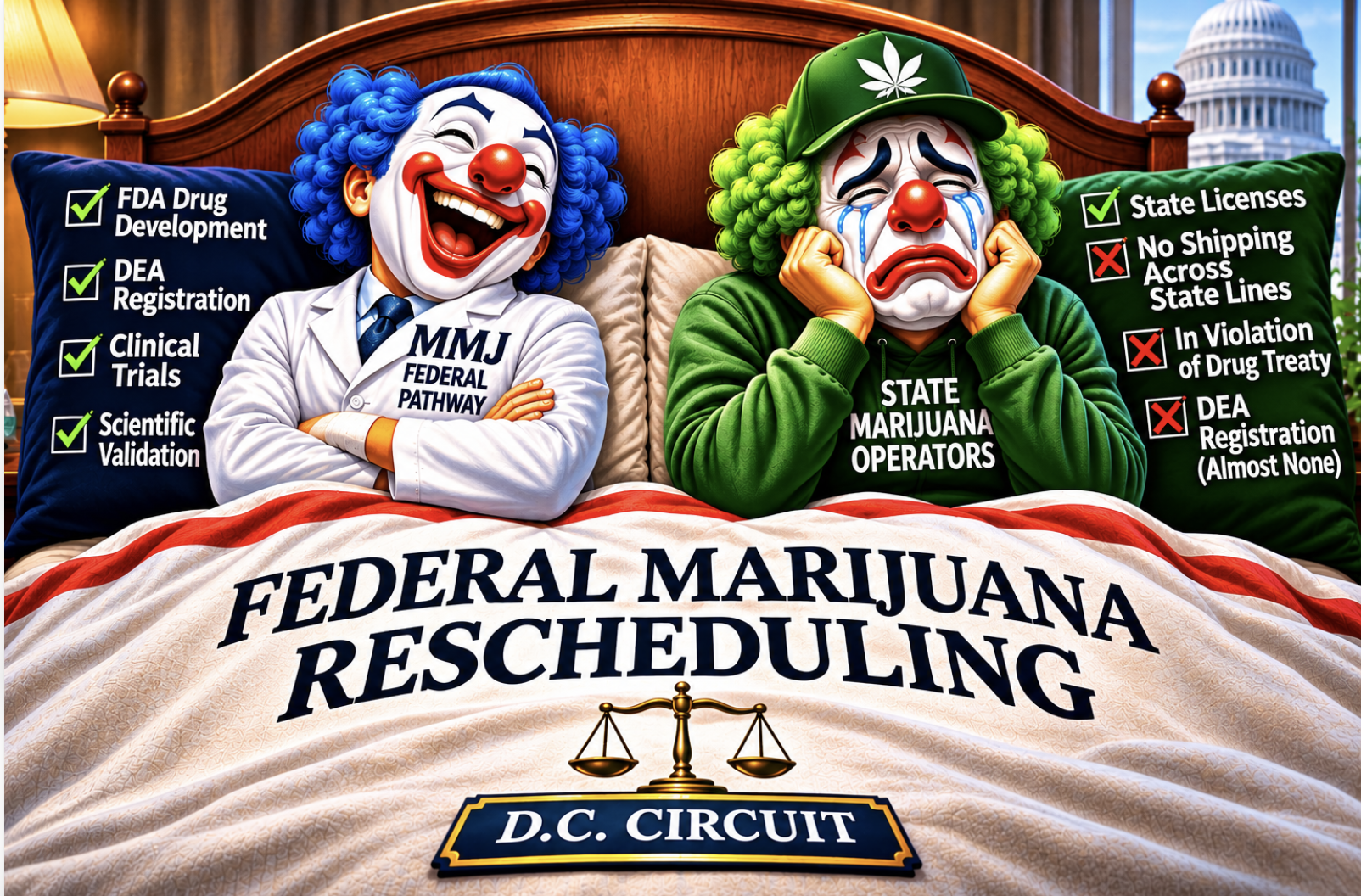
On November 18, 2026, Standard Wellness Utah, LLC, Verde Americano, LLC (Arizona), and NW Confections OK 241AA LLC (Oklahoma) petitioned the U.S. Court of Appeals for the D.C. Circuit for review of DEA's October 30 "Timely Applicant Information." The case is No. 26-1324. A day later, four Pennsylvania operators filed No. 26-1325, which the court consolidated with it. Both groups ask the court to block DEA's November 29 deadline that bars federal applicants from trading with businesses outside the federal system.
"Lawsuits make strange bedfellows," said Duane Boise, CEO of MMJ International Holdings. "In April the industry celebrated the rescheduling order. Now those same operators are in the D.C. Circuit telling the judges that DEA cannot carry it out without destroying their businesses. They are proving MMJ's point: the order was never a lawful federal system. It was a state system wearing a federal label."
What the Operators Admit Under Oath
The operators' emergency motion and supporting declarations describe the state marijuana market in their own words.
State markets, the motion says, "prohibit interstate commerce," leaving operators "entirely dependent on intrastate markets for manufacture, distribution, and dispensing." The petitioners also state that, "to the declarants' knowledge, no Arizona or Oklahoma licensee holds a DEA registration."
The businesses at stake were built long before any federal registration existed. Standard Wellness Utah, the motion says, "spent six years winning shelf space" in Utah pharmacies and grew its revenue fivefold. It applied to DEA in early November 2026. Verde reports wholesale sales averaging about $1.15 million a month - "substantially all" of its revenue - built on customer relationships that took four to five years to develop.
In Utah, the motion explains, DEA's guidance will split the market into five federally "timely" producers selling to 14 timely pharmacies on one side, and seven producers outside the federal system on the other.
"These companies built multimillion-dollar businesses while marijuana was a Schedule I drug, without a single federal registration," Boise said. "Now they tell the court that their entire supply chains exist only inside state lines, and that almost no one in Arizona or Oklahoma holds a DEA registration. That is not a federal medical system. That is the gap MMJ has been describing since April."
Their Argument Is MMJ's Argument, Turned Inside Out
The operators' central complaint is that DEA is now treating businesses differently even though they "hold the same state licenses." In their words, "only the date of a federal filing separates them."
MMJ agrees with the premise and rejects the conclusion. The April Order treated a state license as a substitute for federal review. DEA is now discovering what that means in practice: thousands of state-licensed businesses, few federal registrations, and supply chains whose federal origin no one has established. The operators want the court to protect those supply chains. MMJ is asking the court whether the Order that recognized them was lawful in the first place.
DEA Is Now Issuing "Show Cause" Orders
A DEA Order to Show Cause is a formal notice that the agency is considering denying a registration application (or revoking an existing registration). It requires the applicant to explain why DEA should not take that action. It is not a final decision, but it signals serious concerns and starts a formal administrative process.
According to Marijuana Moment, DEA has sent Show Cause Orders to applicants in California, Delaware, the District of Columbia, Illinois, Minnesota, North Dakota, and Oregon. The orders reportedly cite the Controlled Substances Act's "closed system" and the United States' international treaty obligations as reasons DEA may not be able to register businesses in states that allow non-medical sales.
That is the Single Convention on Narcotic Drugs, 1961 - the same treaty the Attorney General cited to justify the April Order. Article 28 applies the Article 23 control system to cannabis. Under Article 23, only cultivators licensed by the government agency may grow the crop, and they must deliver their total harvest to that agency. Article 33 states that parties "shall not permit the possession of drugs except under legal authority."
"DEA is now invoking the treaty to reject state businesses in seven jurisdictions," Boise said. "MMJ has been raising the same treaty in court since May. If the treaty bars registration in California and Illinois, DEA must explain how marijuana grown for years outside any federal license, and never delivered to any government agency, became treaty-compliant medicine everywhere else."
MMJ's Position
MMJ is not anti-marijuana. MMJ is anti-bad science and anti-fake process. MMJ BioPharma Cultivation, Inc. filed its DEA bulk-manufacturer application on December 27, 2018, to support pharmaceutical cannabinoid development for Huntington's disease and multiple sclerosis. That application remains pending. MMJ BioPharma Labs, Inc. holds a DEA Schedule I analytical laboratory registration.
MMJ International Holdings and its subsidiaries are petitioners in the consolidated D.C. Circuit litigation challenging the April 2026 rescheduling order. The state operators' cases challenge DEA's October 30 guidance, raise different claims, and seek different relief.
About MMJ International Holdings, Inc.
MMJ International Holdings, Inc., through its subsidiaries MMJ BioPharma Cultivation, Inc. and MMJ BioPharma Labs, Inc., is developing investigational pharmaceutical cannabinoid therapies for Huntington's disease and multiple sclerosis through FDA and DEA regulatory pathways. MMJ's investigational drug candidates have not received FDA marketing approval, and their safety and efficacy have not been established through completed clinical trials.
Regulatory and Forward-Looking Notice
Statements in court filings are allegations and declarations that have not been adjudicated. Reports of DEA orders to show cause are based on published news accounts; orders to show cause are not final agency decisions. Litigation outcomes and agency actions remain uncertain.
Media Contact
Madison Hisey
MMJ International Holdings, Inc.
[email protected]
203-231-8583
SOURCE: MMJ International Holdings