




Sunday, 08 November 2026 08:35 PM
Environmental, Social and Governance
CBF, the Forage Fish Campaign and allied advocates turn lower 2025 landings into claims of scarcity while overlooking rough seas during a critical fishing period
WASHINGTON, D.C. / ACCESS Newswire / November 8, 2026 / The Chesapeake Bay Foundation, the Forage Fish Campaign and allied advocates have presented lower 2025 menhaden landings as evidence that the fish are disappearing. Their claims leave out a fundamental fact: commercial fishermen cannot catch fish when weather keeps their vessels from operating.
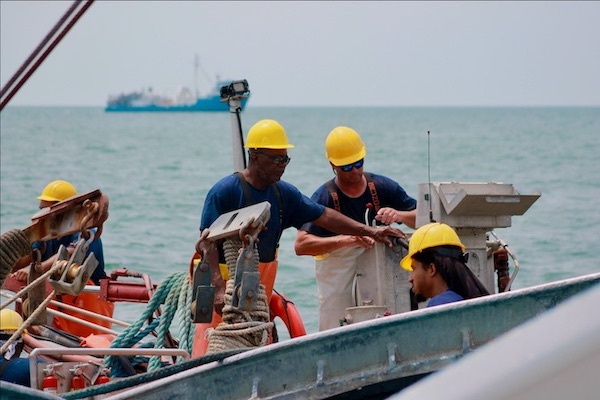
Weather records show that the 2025 season brought a substantial increase in rough conditions along the Mid-Atlantic coast-and that the weather was particularly severe during August through December, an especially important period for the menhaden fishery.
Across 11 coastal forecast zones from the Virginia-North Carolina border to the western New York Bight, the number of days under gale-or-stronger warnings during those five months averaged 53 percent above the preceding ten-year average. Hours under those warnings were 63 percent above average. Both increases were substantially greater than the increases for the full May-December season.
Days with small craft advisories or stronger wind and sea warnings during August through December averaged 20 percent above the previous ten-year average. By that measure, as well as for gale-or-stronger warnings, the five-month period in 2025 was the highest in the 11 years examined.
The timing mattered. August through December is an important period for the fishery as menhaden move south along the coast and fish leave estuaries during the fall migration. Rough weather during those months limited fishermen's opportunities to reach and harvest the migrating schools.
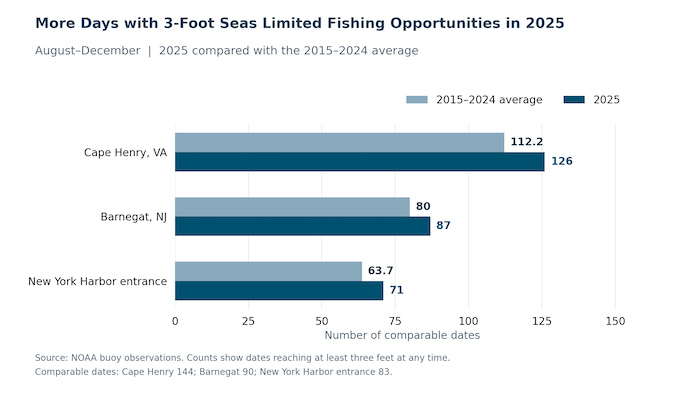
An examination of NOAA buoy records using a three-foot wave threshold-the point at which the menhaden vessels in question cannot fish-also found more affected dates in 2025 than the preceding ten-year average at Cape Henry, Virginia; Barnegat, New Jersey; and the New York Harbor entrance. For comparable August-December dates, all three stations recorded their highest number of dates reaching the three-foot threshold in the 11-year comparison.
The consequences extend beyond one company or one fishery. Rough weather restricts the opportunities available to menhaden fishermen in both the bait and reduction sectors, as well as other commercial vessels that depend on workable conditions to reach their fishing grounds and deploy their gear.
Advocates declare the fish are missing
The Forage Fish Campaign compared the 2025 coastwide catch with the quota and declared that the shortfall occurred because the fish "are simply not out there."
In a separate campaign release, executive director Whit Fosburgh pointed to the gap between coastwide landings and the catch limit and suggested that Atlantic menhaden may already be collapsing.
The Chesapeake Bay Foundation's November 6, 2026 press release, written by David Sherfinski, made the same leap. CBF forage campaign manager Will Poston said the unfilled reduction catch limit makes it clear that menhaden are in trouble. In Sherfinski's release, Brian Brooks of the American Bird Conservancy asserted that the commercial fishery cannot find menhaden, while Kate Wilke of The Nature Conservancy cited the unfilled catch limit as another warning sign and called for reductions.
Poston also dismissed warnings that further restrictions could cause layoffs as "scare tactics," arguing that the reduction fishery caught only 60 percent of its quota in 2025. Poston, whose listed academic background and employment history show no evidence of business studies or responsibility for employees at a for-profit enterprise in the seven years since he graduated from college, apparently considers himself better qualified to judge the employment consequences of menhaden restrictions than the union representing the fishermen or the economists who examined the industry for the ASMFC.
United Food and Commercial Workers Local 400, which represents menhaden fishermen, has warned that further restrictions could threaten the livelihoods and economic security of Northern Neck families. The union has urged the ASMFC to refrain from additional Bay restrictions until ongoing research establishes their necessity.
The ASMFC's Committee on Economics and Social Sciences has likewise warned that the processing plant needs a minimum volume of fish to cover its fixed costs and that sufficiently deep reductions could lead to a complete shutdown, rather than a proportional reduction in jobs. Poston does not address that analysis. He simply dismisses the consequences for the people who would bear them.
Former Maryland Senator Gerald Winegrad also pointed to low 2025 landings and the unfilled allowances in his Capital Gazette commentary.
These statements present the size of the catch as a measure of how many fish were available while leaving out the conditions that determine when fishing vessels can operate. For people seeking to reshape a commercial fishery, that omission reveals an astonishing lack of understanding of commercial fishing.
CBF makes menhaden a fundraising centerpiece
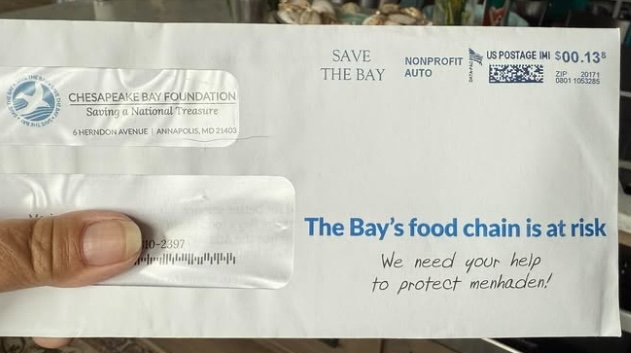
CBF's willingness to make that claim without addressing the weather is hardly surprising. The foundation has made its misleading arguments against the menhaden fishery the centerpiece of its fundraising appeals. One mailing envelope warns that "The Bay's food chain is at risk" and asks recipients for help protecting menhaden. A special menhaden edition of CBF's newsletter promotes a 50 percent cut in the Bay harvest and urges readers to donate while a matching gift is available.
This is a recurring campaign, not a single mailing. CBF has combined its menhaden messaging with donation appeals in other newsletters, and the Menhaden Fisheries Coalition documented a fundraising appeal and matching-gift pop-up accompanying a 2025 CBF release attacking the fishery. CBF is using alarming claims about menhaden both to raise money and to demand restrictions on the fishermen whose livelihoods depend on access to the water.
Rough weather during a critical fishing period
The increase in adverse weather was especially pronounced from August through December.
During those months, the 11 coastal forecast zones averaged approximately 103 days with some small craft advisory or stronger wind and sea warning coverage in 2025, compared with an average of approximately 86 days over the preceding decade. That was a 20 percent increase and the highest average for the period in the 11 years examined.
Gale-or-stronger warnings showed an even larger increase. The zones averaged approximately 29 warning days from August through December 2025, compared with approximately 19 days during the same months in the preceding decade-an increase of 53 percent. The number of hours under those warnings increased 63 percent.
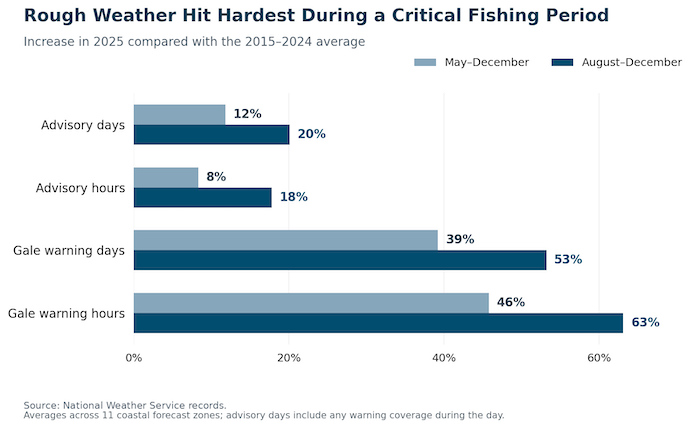
The full-season comparison shows why examining the timing is important. From May through December, days under gale-or-stronger warnings averaged 39 percent above the previous ten-year average, while warning hours were 46 percent above average. Roughly 95 percent of the season's gale-warning days fell between August and December.
That period coincides with the seasonal southward movement of menhaden. The Atlantic States Marine Fisheries Commission describes large schools of menhaden in nearshore and estuarine waters and a southward migration during fall and early winter. Juvenile menhaden also leave estuaries for the ocean in late fall. The migration creates important fishing opportunities-but vessels must have workable weather to take advantage of them.
Three-foot seas and fewer fishing opportunities
The weather analysis examined NOAA wave observations at individual coastal buoy locations. To make the comparison fair despite gaps in historical records, it used the same calendar dates with sufficient observations in every year from 2015 through 2025.
At the Cape Henry buoy, significant wave height reached at least three feet on 126 of the 144 comparable August-December dates in 2025, compared with an average of 112.2 dates during the previous decade. It was the highest count for those dates in the 11-year comparison.
At Barnegat, New Jersey, the three-foot threshold was reached on 87 of 90 comparable dates, compared with a ten-year average of 80 dates. At the New York Harbor entrance, it was reached on 71 of 83 comparable dates, compared with an average of 63.7 dates. Both were the highest counts for those dates in the comparison.
The full May-December comparison also shows more rough conditions in 2025 than the previous ten-year average at all three stations. At Cape Henry, the three-foot threshold was reached on 162 of 203 comparable dates, compared with a ten-year average of 152.3.
These are observations at specific locations. They show that the three-foot threshold was reached more often in 2025, including during the critical August-December period.
Weather affects fishermen's decisions
The relationship between rough weather and fishing activity is documented in peer-reviewed research.
In "How storms affect fishers' decisions about going to sea," NOAA fisheries scientist Lisa Pfeiffer examined vessel-level trip decisions in six U.S. commercial fisheries alongside National Weather Service warnings. The study found that fishermen's tendency to avoid storms increased with warning severity. It included the Mid-Atlantic surfclam and ocean quahog fishery and a New England scallop fishery.
The menhaden industry has also explained why access to sheltered Bay waters matters when ocean conditions are too rough. In a 2025 submission to the Atlantic States Marine Fisheries Commission, Omega Protein and Ocean Harvesters described the limited number of days when weather and sea conditions allow their vessels to operate in the ocean.
Fishermen's ability to operate is not a minor detail in interpreting landings. It determines whether a vessel can leave port, reach fish, make a set and bring its catch home.
A catch limit establishes how much may be harvested. It does not guarantee enough workable weather to catch that amount. Before declaring that an unfilled quota proves the fish are missing, CBF and its allies should account for the conditions fishermen actually faced in 2025.
Sources
Atlantic States Marine Fisheries Commission, Committee on Economics and Social Sciences. (2026, July 13). Updated review of Atlantic menhaden employment impacts [Memorandum].
Atlantic States Marine Fisheries Commission. (2026, November 2). Review of the Interstate Fishery Management Plan for Atlantic Menhaden: 2025 fishing year. Section III, Status of the Fishery.
Atlantic States Marine Fisheries Commission. Atlantic menhaden: Life history and migration.
Chesapeake Bay Foundation. The Bay's food chain is at risk [Fundraising envelope reproduced in this release].
Himchak, P. (2025, July 28). The Menhaden Work Group report and Menhaden Technical Committee tasking at the ASMFC Summer Meeting [Letter to John Clark, Chair, Atlantic Menhaden Management Board]. Omega Protein Corporation. p. 7.
Kensinger, N. (2026, September 25). Save the Bay News: Why menhaden matter. Chesapeake Bay Foundation.
Kuhn, A. (2026, November 6a). New menhaden catch data raises alarm over health of Atlantic ecosystem. Forage Fish Campaign.
Kuhn, A. (2026, November 6b). The Bait Line: The warning signs are flashing red. Forage Fish Campaign.
Menhaden Fisheries Coalition. (2025, July 29). Omega Protein and Ocean Harvesters urge science-based review before imposing new menhaden restrictions. Saving Seafood.
Menhaden Fisheries Coalition. (2025, June 30). Chesapeake Bay Foundation continues to spread menhaden misinformation.
National Oceanic and Atmospheric Administration. NDBC standard meteorological buoy data, 1970-present [Data set]. Stations 44099, 44091 and 44065; May-December 2015-2025. NOAA ERDDAP, dataset cwwcNDBCMet. Retrieved November 7, 2026. May-December and August-December three-foot threshold counts and matched-date comparisons calculated from these observations.
National Weather Service. Marine advisory and warning records, 2015-2025 [Data set]. Wakefield, Mount Holly and New York forecast offices. May-December and August-December advisory-day and warning-hour comparisons calculated across 11 coastal forecast zones.
Pfeiffer, L. (2020). How storms affect fishers' decisions about going to sea. ICES Journal of Marine Science, 77(7-8), 2753-2762. https://doi.org/10.1093/icesjms/fsaa145
Poston, W. LinkedIn profile.
Sherfinski, D. (2026, November 6). Menhaden fishery falls far short of Chesapeake Bay catch limit. Chesapeake Bay Foundation.
United Food and Commercial Workers Local 400. (2026, October 27). UFCW Local 400 statement on proposed Chesapeake Bay menhaden cuts.
Winegrad, G. (2026, November 6). [Commentary on menhaden and osprey]. Capital Gazette.
About the American Small Pelagics Network
The American Small Pelagics Network represents fishermen, processors, suppliers, and coastal communities connected to fisheries such as menhaden, mackerel, herring, squid, and butterfish. ASPN supports sustainable fisheries management that supports critical fish species, while maintaining economic opportunities for fishermen and fishing communities.
Press Contact
Stove Boat Communications
202-595-1212
[email protected]
SOURCE: American Small Pelagics Network