
Press Release Format: How to Make the Most of Your Campaigns
Does your press release format really matter?
The short answer is yes.
But, that’s not helpful.
If you landed on this blog, you want to know why.
And, in this article, we’re going to tell you as we cover:
- The benefits of a properly formatted press release
- How to make sure your press release format amplifies your message
- How to format a press release in AP style
Format is just one piece of a strong release. For the complete walkthrough, see our guide on how to write a press release .
The Benefits of a Properly Formatted Press Release
Have you ever read a press release and afterwards thought to yourself, “
wait, what did I just read?
”
Those feelings of frustration and confusion can leave a bad taste in your mouth.
When it comes to writing a press release of your own, you want to avoid creating that same experience for your readers.
This is where the format of your press release plays an important role.
Think of your press release format as setting the table for a dinner party.
You want to make sure everyone has what they need (important details,
readability
, etc.) to enjoy the meal (your press release).
How to Amplify Your Message with Your Press Release Format
Your press release format sets your campaign up for success.
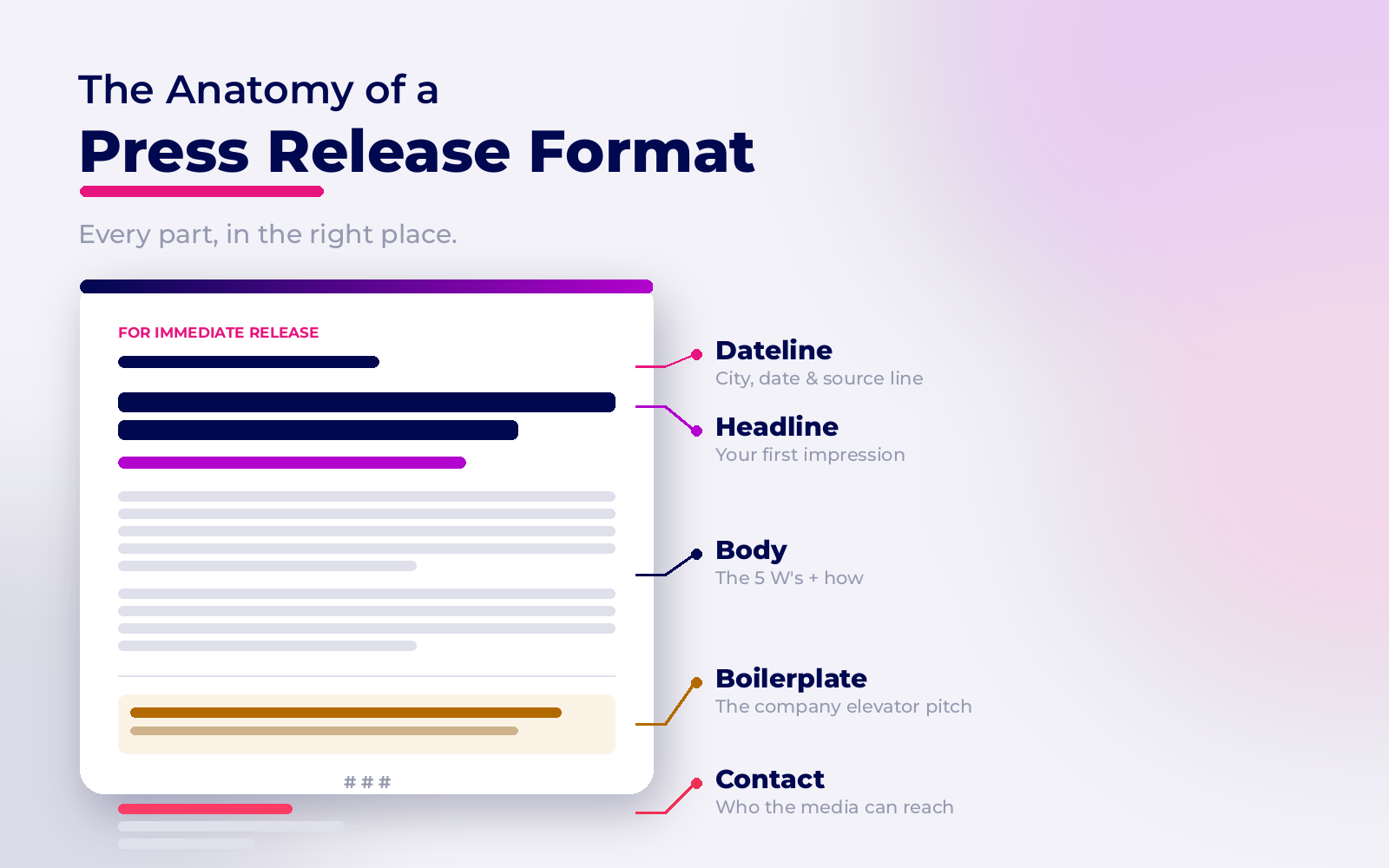
Here are the pieces your press release needs to include.
Dateline
The dateline of your press release should include:
- The location
- Date of publication
Your dateline should look like this:
RALEIGH, NC / ACCESS Newswire / July 7, 2023 /
Headline
The headline of your press release is your content’s first impression.
It’ll either capture people’s attention or leave them scrolling.
Make sure your headline is worth clicking and check out our
Press Release Headline Tips
blog.
Summary
You'll find the press release summary between the headline and body text.
This part of the press release is essentially an overview of what the reader can expect from your press release.
To make the most of this section, make sure your press release summary:
- Supports the press release headline
- Provides more information
- Leverages keywords
- Highlights newsworthiness
- Piques interest
First paragraph
Your first paragraph is the most important. It should cover the 5 W's + How, otherwise known as the
inverted pyramid
:
- Who
- What
- Where
- When
- Why
- How
Multimedia
Your press release should include at least one high-quality image or video.
Your multimedia is shareable content and can increase the chances of your press release getting the media's attention.
Quotes
Don’t treat your quotes as an afterthought.
Quotes are typically the part of a press release that gets shared. Make sure they drive home the topic of your campaign.
Call-to-action
The end of your press release is the perfect time to insert a call-to-action. Your call-to-action should be simple, to the point, and align with the goal of the campaign.
For example, if you want people to attend your webinar, you could say, “Visit URL to save your seat at NAME OF WEBINAR!”
Boilerplate
This is the final paragraph of your press release.
Your
boilerplate
should share information about your company, what it does and offers, and any awards and accolades you’ve earned. Think of it as an elevator pitch. It’s short, impactful and necessary.
Hyperlinks
Your press release should include at least three to five hyperlinks. You can place these hyperlinks in the introduction, one or two throughout the body text, and one in the boilerplate.
When adding hyperlinks to your press release, try to use your target keyword as the clickable text of the link.
Contact information
Always include the contact information of the person in your organization who the media can reach out to. Add the contact information at the end of your press release.
Here’s an example from our press releases:
ACCESS Newswire Media Contacts:
Brian R. Balbirnie
+1 919-481-4000
[email protected]
Jennifer Hammers
+1 919-481-4000
[email protected]
Press Release Format in AP Style
Most newsrooms write in AP (Associated Press) style, so formatting your press release the same way makes it easier for journalists to pick up and run your story as-is. Here are the AP style rules that matter most for a press release:
- Dates – Use numerals, and abbreviate months longer than five letters (Jan., Feb., Aug., Sept., Oct., Nov., Dec.). Spell out March, April, May, June, and July.
- Dateline – Open with the city in all capital letters, followed by the state where one is needed — for example, RALEIGH, N.C. Major cities such as ATLANTA, BOSTON, CHICAGO, NEW YORK, and WASHINGTON stand alone without a state.
- Numbers – Spell out one through nine; use numerals for 10 and up.
- Punctuation – Use one space after a period, and skip the serial (Oxford) comma before the last item in a series.
- Perspective – Write in the third person. Never use the first person (I or we) or second person (you).
- Fonts – Stick to a clean, standard typeface like Arial or Times New Roman.
When your release already follows AP style, journalists don’t have to reformat it, the key facts are easy to scan, and it’s far more likely to get picked up and published as written.
If you need help making sure your press release format is spot on every time, download our free press release template .
Search: